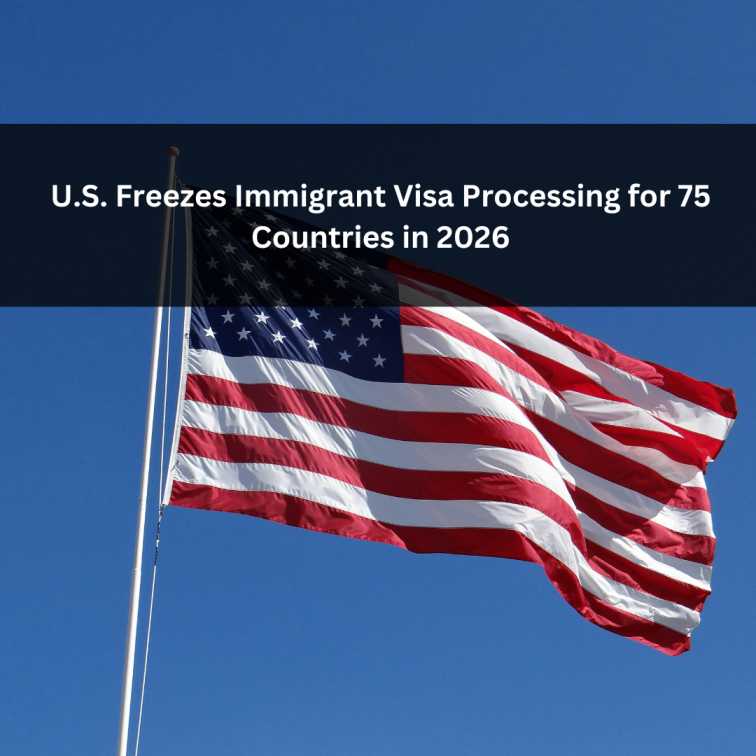
In a sweeping move that is reshaping legal pathways to the United States, the Trump administration has announced it will pause processing immigrant visas for citizens of 75 countries starting January 21, 2026. This decision marks one of the most significant shifts in U.S. immigration policy in years, with broad implications for families, workers, and global communities aspiring to move to the United States. (Reuters)
What Is Being Suspended?
Under the new directive from the U.S. Department of State, immigrant visa processing — the consular step that grants permanent residency (commonly known as a “Green Card”) to people abroad — will be indefinitely frozen for nationals of 75 countries. The suspension applies only to immigrant visas, not to temporary or non-immigrant categories such as tourist, student, or work visas. (WeGreened.com)
In practical terms:
- Immigrant visas for family reunification, employment-based residency, and other permanent pathways will not be issued to applicants from affected countries.
- Non-immigrant visas (like tourist, business, student, or temporary worker visas) remain available — though heightened scrutiny may affect approvals. (WeGreened.com)
Who Is Affected?
Countries impacted include a wide range across Africa, Asia, the Caribbean, Latin America, the Middle East, and Eastern Europe. Some of the better-known nations on the list are Afghanistan, Brazil, Nigeria, Iran, Russia, Somalia, and Pakistan, among many others. (WeGreened.com)
Not all countries are affected — for example, Kenya and Burundi were reported to be exempt from the suspension. (The Star)
Why Is This Happening?
According to the State Department, the policy is rooted in public charge concerns — the idea that new immigrants should be financially self-sufficient and not likely to depend on U.S. public assistance programs. The administration says it wants to revise how consular officers evaluate visa applicants, placing stronger emphasis on financial stability and other criteria to prevent “abuse” of the immigration system. (WBUR)
This reasoning builds on existing U.S. immigration law that allows visa denial to applicants considered likely to become a “public charge.” However, this suspension dramatically expands how the rule is applied by halting final visa issuance for entire countries. (The Washington Post)
What This Doesn’t Mean
It’s important to understand what the policy does not do:
- It isn’t a total travel ban — people from affected nations can still apply for short-term visas and visit the U.S.
- It doesn’t cancel existing visas that have already been issued (though some reports suggest consular officers may reverse recently approved cases if visas haven’t been printed yet). (Reddit)
- It currently does not apply to immigration applications filed inside the United States (such as adjustment of status). (WeGreened.com)
Who Will Feel the Impact?
Families and individuals who were in the final stages of immigrating — especially those with approved petitions waiting for consular interviews — are among the most immediately affected. This includes workers sponsored by employers abroad and relatives of U.S. citizens. (The Guardian)
Legal advisors say that employers and families may face indefinite delays and should plan for longer timelines or consider alternative visa paths where possible. (WeGreened.com)
Criticism and Broader Context
Critics argue this policy amounts to one of the most restrictive immigration measures in recent U.S. history. Some analysts warn that freezing immigrant visas will not only separate families and workers but might also have economic downsides, given immigrants’ roles in filling labor shortages and contributing to growth. (Barron’s)
Others highlight that the criteria used to define “public charge” are controversial and may unfairly target people from lower-income countries. (The Washington Post)
What Comes Next?
At the moment, the policy has been implemented without a clear end date, meaning the pause could continue indefinitely while the State Department revises its procedures. Observers are watching for:
- Whether the suspension will lead to formal regulatory changes
- How U.S. Citizenship and Immigration Services (USCIS) might respond domestically
- Legal challenges from advocacy groups and affected individuals
For more immigration news visit our “Travel News” Category