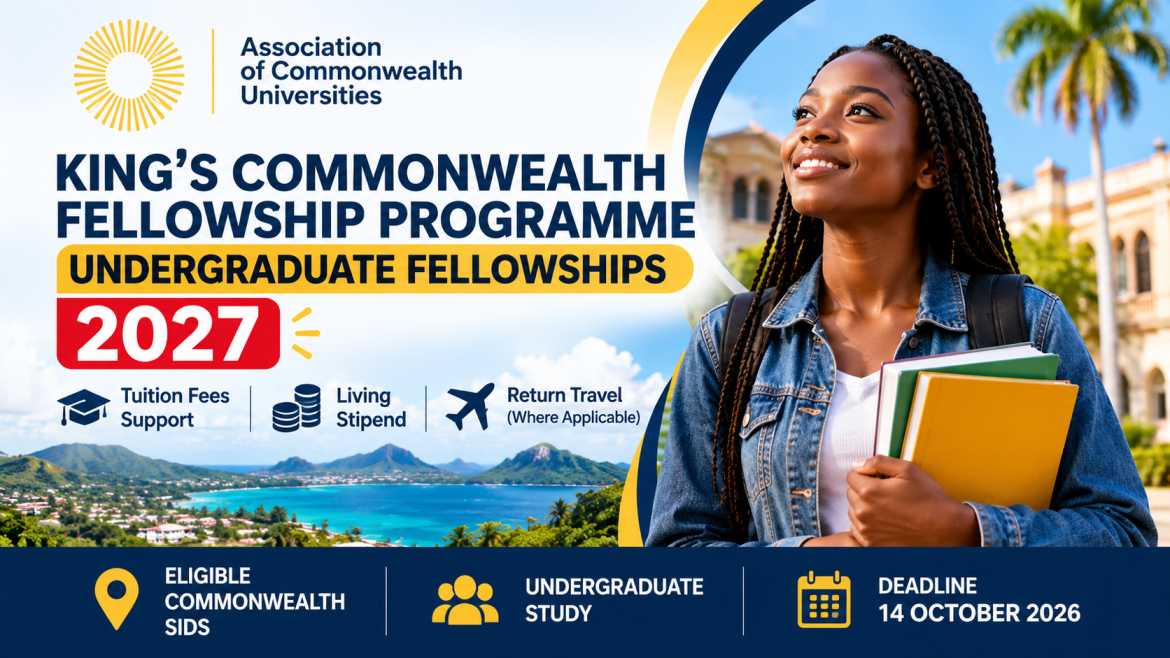
The King’s Commonwealth Fellowship Programme (KCFP) Undergraduate Fellowships 2027 is now accepting applications from talented young people from eligible Commonwealth Small Island Developing States (SIDS) who are preparing to begin undergraduate studies in 2027.
The programme is designed to help young people gain the academic knowledge, professional skills and leadership experience needed to contribute to the development of their home communities.
Rather than requiring students to travel overseas, the fellowship supports undergraduate study at approved universities within their home country or immediate region, depending on the availability of an approved host institution.
Successful Fellows can receive support towards tuition fees, living expenses and annual return travel to their home island, where applicable.
The programme focuses on strengthening local talent in areas that are important to the long-term development and resilience of island communities, including education, engineering, healthcare and sustainable tourism.
King’s Commonwealth Fellowship 2027 – Quick Overview
| Category | Details |
| Programme | King’s Commonwealth Fellowship Programme Undergraduate Fellowships |
| Study Level | Undergraduate |
| Study Period | 2027 |
| Eligible Regions | Commonwealth Small Island Developing States |
| Study Location | Home country or immediate region |
| Funding | Tuition, stipend and return travel where applicable |
| Sponsor | Association of Commonwealth Universities (ACU) |
| Eligible Applicants | Citizens or refugees from eligible Commonwealth SIDS |
| Gender | Open to men and women |
| Application Deadline | 14 October 2026 |
What Is the King’s Commonwealth Fellowship Programme?
The King’s Commonwealth Fellowship Programme is designed to support talented young people from Commonwealth Small Island Developing States who want to pursue undergraduate education and build careers that contribute to their communities.
Many small island nations face challenges including climate change, limited access to specialized skills and shortages of professionals in important sectors.
The fellowship seeks to address some of these challenges by investing in young people and supporting them to study subjects that can contribute to national development.
A major feature of the programme is its focus on local and regional education. Fellows are expected to study at an approved host university in their home country where possible. If there is no approved institution in their country, they may be able to study at a participating university elsewhere within their immediate region.
What Does the Fellowship Cover?
Selected students can receive several forms of financial assistance throughout their studies.
- Full Tuition Fees: The programme can cover full tuition fees where those fees are not already covered by the government. Applicants should therefore check the funding arrangements applicable to their chosen country and university.
- Living Stipend: Fellows receive a stipend to help cover basic living expenses while undertaking their studies.
- Return Travel: Where applicable, the programme provides one return ticket to the Fellow’s home island for each year of study.
This can help students maintain connections with their home communities while completing their education.
Who Can Apply?
This opportunity is specifically designed for applicants from eligible Commonwealth Small Island Developing States.
Eligible applicants must have citizenship or refugee status in one of the countries listed below.
Caribbean and Americas
Eligible countries include:
- Antigua and Barbuda
- Bahamas
- Barbados
- Belize
- Dominica
- Grenada
- Guyana
- Jamaica
- Saint Kitts and Nevis
- Saint Lucia
- Saint Vincent and the Grenadines
- Trinidad and Tobago
Indian Ocean
Eligible countries include:
- Maldives
- Mauritius
- Seychelles
Pacific
Eligible countries include:
- Fiji
- Kiribati
- Nauru
- Papua New Guinea
- Samoa
- Solomon Islands
- Tonga
- Tuvalu
- Vanuatu
Important: This is not a general scholarship for all Commonwealth countries. Applicants must come from one of the eligible Commonwealth SIDS listed above.
Eligibility Requirements
Applicants must satisfy all of the programme’s eligibility requirements.
1. Be From an Eligible Commonwealth SIDS
You must have citizenship or refugee status in one of the participating countries listed in the official eligibility requirements.
2. Begin Undergraduate Studies in 2027
Applicants must be due to commence their undergraduate programme between January and December 2027.
3. Not Already Hold a Higher Education Qualification
Applicants must not already have a higher education qualification.
This includes:
- Bachelor’s degrees
- Postgraduate qualifications
- Other higher education qualifications
The programme is intended for students who are entering undergraduate-level study.
4. Choose an Approved Degree Programme
Applicants must select an undergraduate programme included on the approved list for their chosen host university.
Applications for programmes that are not included on the published list will not be considered.
Where Will Fellows Study?
One of the distinctive features of this programme is that Fellows generally study within their own country or region.
Applicants should undertake their studies at an approved KCFP Host University located in their home country whenever an eligible institution is available.
If there is no participating university in the applicant’s home country, the programme allows for study at an approved institution located within the applicant’s immediate region.
The participating institutions include:
- Fiji National University
- National University of Samoa
- Papua New Guinea University of Technology
- University of Belize
- University of Mauritius
- University of Technology, Mauritius
- University of the West Indies – Cave Hill
- Villa College
The available degree programmes vary depending on the university and eligible country.
Applicants should therefore check the official programme guidance carefully before selecting a course.
What Can Students Study?
The fellowship is intended to support fields that can help address skills needs and contribute to sustainable development in participating island nations.
The available programmes vary by host university.
Potential areas represented within the programme include fields connected to:
- Education
- Engineering
- Health
- Sustainable tourism
- Community development
- Other nationally important sectors
Applicants should not assume that every subject is available at every participating university.
The official list of approved programmes should be checked before applying.
Why Is This Fellowship Important?
Small Island Developing States face unique economic, environmental and social challenges.
Climate change, limited resources, population pressures and shortages of specialized professionals can make it difficult for some countries to develop the workforce required for long-term growth.
By supporting young people through university education, the programme aims to strengthen local capacity and help participating countries develop professionals who can contribute to essential services and national priorities.
The fellowship also provides students with access to a wider professional community through the Commonwealth alumni network.
Benefits Beyond Financial Support
The programme is not only about paying for university.
Fellows can also benefit from:
- Professional development
- Leadership opportunities
- International connections
- Commonwealth networking
- Alumni engagement
- Exposure to other young professionals
- Skills that can be applied within their home communities
These opportunities can help students build relationships and professional networks that continue beyond their undergraduate studies.
Who Should Consider Applying?
This opportunity may be suitable if you:
- Come from one of the eligible Commonwealth SIDS
- Are preparing to start university in 2027
- Have not previously completed a higher education qualification
- Want to study in an approved undergraduate programme
- Are interested in contributing to your country’s development
- Want to build professional skills in an important sector
- Meet the admission requirements of your selected university
Before applying, make sure both the fellowship eligibility requirements and the university’s admission requirements are satisfied.
Can Africans Apply?
Some African applicants can apply, but eligibility is limited to the participating African Commonwealth SIDS listed under the programme.
The eligible African countries include:
- Mauritius
- Seychelles
Applicants from other African Commonwealth countries are not eligible for this particular fellowship unless the official programme rules are subsequently changed.
How to Apply
Applications are submitted online through the Association of Commonwealth Universities (ACU).
- Step 1: Confirm Your Country Eligibility: Check that you are a citizen or eligible refugee from one of the participating Commonwealth SIDS.
- Step 2: Identify an Approved Host University: Find out which participating university and undergraduate programmes are available to applicants from your country.
- Step 3: Check the Degree Requirements: Each university and programme may have its own admission requirements. Make sure you satisfy those requirements before applying.
- Step 4: Prepare Your Application: Gather the information and documents requested in the official application guidance.
- Step 5: Submit Your Application Online: Complete the application through the official ACU application platform.
- Step 6: Apply Before the Deadline: The closing date is 14 October 2026. Applicants should submit their applications before the deadline rather than waiting until the final day.
VISIT OFFICIAL WEBSITE TO APPLY
Frequently Asked Questions
What is the King’s Commonwealth Fellowship Programme?
It is a fellowship programme supporting undergraduate students from eligible Commonwealth Small Island Developing States to study at approved universities in their home country or immediate region.
Is the programme fully funded?
The fellowship provides financial support including tuition fees where applicable, a living stipend and return travel to the student’s home island where applicable.
The exact funding arrangements can depend on the student’s circumstances and the applicable government or university funding.
What level of study is supported?
The 2027 programme supports undergraduate study.
When must students begin their studies?
Successful applicants must be due to begin their undergraduate programme between January and December 2027.
Can someone who already has a bachelor’s degree apply?
No. Applicants must not already hold a higher education qualification, including a bachelor’s degree or postgraduate qualification.
Can I study outside my home country?
The programme prioritizes study at an approved host university in the applicant’s home country.
If there is no participating host institution in the applicant’s country, the student may be able to study at an approved university within their immediate region.
Which universities participate?
Participating institutions listed for the programme include Fiji National University, National University of Samoa, Papua New Guinea University of Technology, University of Belize, University of Mauritius, University of Technology Mauritius, University of the West Indies – Cave Hill and Villa College.
Can I choose any university?
No. Applicants must choose from the approved host universities and programmes listed for their country.
Can I study any course?
No. Only undergraduate programmes included in the official approved programme list are considered.
Is there an age limit?
The eligibility information provided for this fellowship does not state a general age limit. Applicants should focus on the stated academic, nationality and programme requirements and consult the official guidance for any additional conditions.
Can a Nigerian student apply?
No. Nigeria is not included among the eligible Commonwealth Small Island Developing States for this programme.
Can students from Mauritius apply?
Yes. Mauritius is included among the eligible Indian Ocean Commonwealth SIDS.
Can students from Seychelles apply?
Yes. Seychelles is included among the eligible countries.
What does the living stipend cover?
The stipend is intended to help Fellows meet basic living costs while studying. Applicants should consult the official guidance for the applicable funding details.
Does the programme cover travel?
Where applicable, Fellows receive one return ticket to their home island for every year of study.
When is the application deadline?
The application deadline is 14 October 2026.
Final Thoughts
The King’s Commonwealth Fellowship Programme Undergraduate Fellowships 2027 is designed to help talented young people from eligible Commonwealth Small Island Developing States access undergraduate education while developing skills that can contribute to their communities and national economies.
The financial package can include tuition fees, a living stipend and annual return travel, depending on the applicable conditions.
However, this is a highly specific regional opportunity. Before beginning an application, prospective candidates should first confirm that their country is on the eligible SIDS list and that their intended degree programme is included among the approved courses at a participating university.
Application Deadline: 14 October 2026
Official application portal:
https://crm.acu.ac.uk/form/kcfp-undergraduate-applications
Official programme information:
https://www.acu.ac.uk/funding-opportunities/for-students/scholarships/the-king-s-commonwealth-fellowship-programme/king-s-commonwealth-fellowship-programme-undergraduate-fellowships/
Check other opportunities:
Italian Innovation Challenge 2026: Fully Funded Trip to Rome, Italy
Erasmus Mundus Scholarship 2027: Fully Funded Master’s Opportunities in Europe
Japan Teaching Jobs 2027: Peppy Kids Club Hiring English Teachers With Visa Sponsorship
Airbus Global Graduate Program 2027 in France – Paid Graduate Jobs with Airbus
Mandela Washington Fellowship 2027: Fully Funded U.S. Leadership Program for Young African Leaders
Australia Announces Major Immigration Changes in 2026: New Rules for Student, Visitor and Work Visas