Canada remains one of the world’s most popular destinations for international visitors, students, skilled workers and families looking for long-term immigration opportunities.
Whether your goal is to visit Canada for tourism, study at a Canadian institution, work for a Canadian employer, reunite with family or eventually become a permanent resident, the application process depends on the immigration program that matches your situation.
This comprehensive Canada visa guide explains the major pathways, documents you may need, how to apply through the official Canadian government website, what happens after you submit your application, how biometrics work, how to check your application status and what to do if your application has been pending for a long time.
Important: Canadian immigration rules, fees, eligibility requirements and processing times can change. Always verify the latest requirements on the official Government of Canada website before submitting an application.
Canada Visa and Immigration Options at a Glance
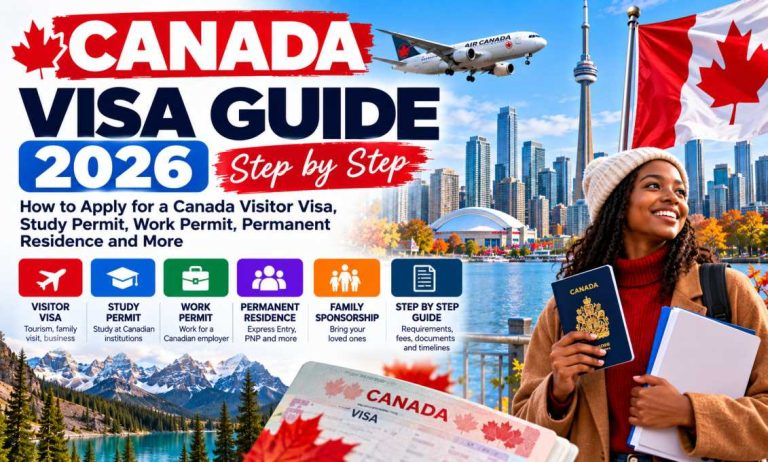
There is no single “Canada visa” that everyone applies for. The correct application depends on what you intend to do in Canada.
The major pathways include:
- Visitor visa – for tourism, visiting family or friends, business visits and other temporary purposes.
- Super visa – for eligible parents and grandparents of Canadian citizens or permanent residents.
- Study permit – for eligible international students who want to study in Canada.
- Work permit – for foreign nationals who are eligible to work temporarily in Canada.
- Express Entry – a major pathway to permanent residence for eligible skilled workers.
- Provincial Nominee Programs (PNPs) – provincial and territorial immigration programs that can lead to permanent residence.
- Family sponsorship – allows eligible Canadian citizens and permanent residents to sponsor certain family members.
- Other economic immigration programs – Canada also has other programs for specific occupations, communities, entrepreneurs and other categories.
The first step is therefore to identify the immigration pathway that matches your purpose.
1. How to Apply for a Canada Visitor Visa
A Canadian visitor visa, officially called a Temporary Resident Visa (TRV), is a visa placed in your passport that allows you to travel to Canada and seek entry as a temporary visitor.
People commonly apply for a visitor visa to:
- Visit family or friends
- Take a holiday
- Attend a business meeting
- Attend certain events
- Visit Canada for tourism
- Make a short personal visit
- Visit for certain compassionate reasons
Who Can Apply for a Canada Visitor Visa?
Applicants generally need to demonstrate that they:
- Have a valid travel document such as a passport
- Meet Canada’s admissibility requirements
- Have sufficient funds for their visit
- Have ties to their home country
- Will leave Canada at the end of their authorized stay
- Have a genuine temporary purpose for travelling
Depending on your circumstances, IRCC may also require a medical examination, additional documents or other information.
Documents You May Need
Your personalized IRCC checklist will determine exactly what you need, but supporting documents can include:
- Valid passport
- Completed application information
- Proof of funds
- Bank statements
- Employment evidence
- Business documents, where applicable
- Travel history
- Invitation letter, where applicable
- Accommodation information
- Travel itinerary
- Evidence of family or social ties
- Proof of relationship to someone in Canada, where relevant
- Additional documents requested by IRCC
The most important principle is to provide genuine, consistent and verifiable information.
Visitor Visa Application Fee
The current visitor visa processing fee is CAN$100 per applicant. A family of five or more applying together can have a maximum visitor visa fee of CAN$500. A biometrics fee may also apply.
APPLY FOR A CANADA VISITOR VISA — OFFICIAL IRCC PORTAL
2. How to Apply for a Canada Study Permit
If you want to study in Canada as an international student, you will generally need a study permit.
A study permit is not itself a visa. If you are approved, IRCC may also issue the appropriate travel document or authorization you need to enter Canada depending on your nationality and circumstances.
Step 1: Choose a Canadian School
Before applying for a study permit, you generally need a Letter of Acceptance (LOA) from a Canadian Designated Learning Institution (DLI).
You can search the official DLI list here:
Canada Designated Learning Institutions — Official List
Make sure you check whether your specific program and institution meet the requirements for the immigration pathway you intend to use.
Step 2: Obtain Your Letter of Acceptance
Once a school accepts you, you will normally receive an official Letter of Acceptance.
The document can contain important information such as:
- Your program
- Tuition information
- Start date
- Expected completion date
- Registration information
Step 3: Check Whether You Need a PAL/TAL
Many study permit applicants need a Provincial Attestation Letter (PAL) or Territorial Attestation Letter (TAL).
The PAL/TAL confirms that the province or territory has allocated space for the applicant. There are exceptions depending on the applicant and program.
Quebec has its own requirements, including the Quebec Acceptance Certificate (CAQ) in situations where it applies.
Step 4: Prepare Proof of Financial Support
You need to demonstrate that you have enough money to support yourself during your studies and comply with the financial requirements applicable to your application.
Your financial documentation should be genuine and consistent with the information in your application.
Step 5: Apply for the Study Permit
Use the official IRCC study permit application instructions:
CANADA STUDY PERMIT — HOW TO APPLY
IRCC recommends submitting a complete application because missing information or documents can cause delays or other problems.
3. Can You Work in Canada After Studying?
Some international students may qualify for a Post-Graduation Work Permit (PGWP) after completing an eligible program.
However, completing a Canadian program does not automatically guarantee a PGWP.
Eligibility depends on several factors, including the institution, program, study requirements and other rules applicable to your situation. Current PGWP rules also include language and, for some programs, field-of-study requirements.
Before paying tuition, students should therefore check whether their specific institution and program are eligible for the post-graduation pathway they are considering.
Check Current PGWP Eligibility Requirements
4. How to Apply for a Canada Work Permit
If your goal is to work in Canada temporarily, you need to determine which type of work permit you may qualify for.
The two broad categories are:
Employer-Specific Work Permit
An employer-specific work permit generally identifies the employer, location and occupation under which you are authorized to work.
Many employer-specific work permit applications require a Canadian job offer and, depending on the position, an LMIA (Labour Market Impact Assessment) or another basis for exemption.
Open Work Permit
An open work permit can allow an eligible person to work for different employers rather than being tied to one specific employer.
However, open work permits are only available to people who meet specific eligibility requirements. Most people applying from outside Canada cannot simply request an open work permit without qualifying under an applicable category.
Be Careful With “Canada Visa Sponsorship Jobs”
One of the biggest mistakes job seekers make is assuming that every Canadian employer can sponsor a foreign worker.
A genuine Canadian job opportunity does not automatically mean that the employer will provide immigration support.
For many employer-specific work permits, the employer must complete certain steps before the foreign worker can apply. This may include obtaining an LMIA where required.
Do not pay someone simply because they promise a guaranteed Canadian job or guaranteed visa.
Official Canada Work Permit Information
CANADA WORK PERMITS — OFFICIAL IRCC INFORMATION
5. How to Apply for Canadian Permanent Residence
If your long-term goal is to settle in Canada, you may need to apply for permanent residence rather than a temporary visa.
There are several permanent residence pathways.
Express Entry
Express Entry manages applications for several economic immigration programs.
Depending on your circumstances, these can include:
- Federal Skilled Worker Program
- Federal Skilled Trades Program
- Canadian Experience Class
You first determine whether you qualify, create an Express Entry profile and enter the pool if eligible.
If you receive an Invitation to Apply (ITA), you can submit your permanent residence application.
An ITA is time-sensitive: IRCC states that invited candidates have 60 calendar days to submit their permanent residence application.
OFFICIAL EXPRESS ENTRY INFORMATION
6. Provincial Nominee Programs (PNP)
Canada’s provinces and territories operate immigration programs designed to nominate eligible candidates for permanent residence.
Requirements differ significantly from one province or territory to another.
A candidate may need factors such as:
- Relevant work experience
- Education
- Language ability
- A job offer in some streams
- Connection to the province
- Occupation or sector experience
- Other provincial requirements
For Express Entry-linked PNP pathways, a provincial nomination can provide additional points in the Express Entry system.
EXPLORE CANADA’S PROVINCIAL NOMINEE PROGRAMS
7. Family Sponsorship
Canada also has family sponsorship programs.
Eligible Canadian citizens and permanent residents may be able to sponsor certain family members, depending on the program’s requirements.
For example, there is a pathway for sponsoring an eligible:
- Spouse
- Common-law partner
- Conjugal partner
- Dependent child
The sponsorship process involves both a sponsorship application and a permanent residence application.
SPONSOR YOUR SPOUSE, PARTNER OR CHILD — OFFICIAL CANADA WEBSITE
8. Canada Super Visa for Parents and Grandparents
The Super Visa is designed for eligible parents and grandparents of Canadian citizens, permanent residents or registered Indians.
It is different from a regular visitor visa.
Eligible super visa holders can stay in Canada for extended periods, subject to the applicable rules and entry authorization. Current IRCC information says people applying under the current rules may be eligible to stay for up to 5 years at a time.
Applicants must meet requirements involving their host, finances, medical examination and health insurance, among other conditions.
CANADA SUPER VISA — OFFICIAL INFORMATION
9. Biometrics for a Canada Visa Application
Many applicants for Canadian visitor visas, study permits and work permits need to provide biometrics.
Biometrics generally means:
- Fingerprints
- Photograph
The current individual biometrics fee is CAN$85, while eligible families applying together can have a maximum biometrics fee of CAN$170.
If you need biometrics, IRCC will normally issue a Biometric Instruction Letter (BIL) after you apply.
You should then book an appointment at an official biometric collection location.
FIND A CANADIAN VISA APPLICATION CENTRE (VAC)
Biometrics appointments are free to book. Be careful of people or websites asking you to pay them simply to “secure” a biometric appointment.
10. How Much Does a Canada Visa Cost?
Canadian immigration fees depend on the application.
Some current examples include:
| Application | Current fee |
| Visitor visa | CAN$100 |
| Work permit | CAN$155 |
| Open work permit holder fee, where applicable | CAN$100 |
| Biometrics | CAN$85 |
| Study permit | Check the current IRCC fee list |
| Permanent residence | Depends on the immigration program |
Fees can change, so applicants should always check the official IRCC fee list before paying.
OFFICIAL CANADA IMMIGRATION FEE LIST
11. What Documents Do You Need for a Canada Visa?
There is no single document list that applies to every applicant.
IRCC creates a personalized document checklist based on your application.
However, depending on your pathway, you may need documents such as:
Identity Documents
- Valid passport
- Passport photographs where required
- Birth certificate
- Marriage certificate, if applicable
- National identification documents where applicable
Financial Documents
- Bank statements
- Employment income
- Salary slips
- Tax documents
- Business records
- Proof of assets
- Sponsor or financial support documents, where applicable
Employment Documents
- Employment letter
- Payslips
- Employment contract
- Business registration
- Business bank statements
- Evidence of professional activities
Education Documents
For students, this may include:
- Letter of Acceptance
- PAL/TAL, where required
- Academic certificates
- Transcripts
- Proof of tuition payment, where applicable
- Financial support documents
Travel Documents
Depending on your circumstances:
- Previous visas
- Entry and exit stamps
- Previous passports
- Travel history
- Invitation letter
- Travel itinerary
Never submit fake documents or information. IRCC can verify information and may refuse applications where applicants provide false or misleading information.
12. How Long Does a Canada Visa Application Take?
There is no universal processing time for all Canadian visa applications.
Processing times can vary depending on:
- Application type
- Country where you apply
- Whether your application is complete
- How easily IRCC can verify your information
- Whether additional documents are requested
- Whether an interview or medical examination is required
- Application volumes
- Other factors
IRCC specifically states that processing-time estimates are not a maximum or a guarantee.
Check the Current Processing Time
Do not rely on an old blog post or social media screenshot showing a processing time from months ago.
Check the official tool before planning your travel.
CHECK CURRENT CANADA IMMIGRATION PROCESSING TIMES
13. What If You Applied for a Canada Visa Months Ago and Have No Response?
This is one of the most common questions applicants ask.
If your application has been pending for a long time, do not automatically assume that it has been refused or approved.
First, check the current processing time for your application type and country.
Then check your IRCC account for:
- Messages
- Requests for additional documents
- Biometrics information
- Medical examination requests
- Passport requests
- Application status updates
You can check your application status using IRCC’s online tools.
What If Your Application Has Gone Beyond the Normal Processing Time?
If your application has exceeded the normal processing time, you can consider contacting IRCC through the official web form.
However, IRCC says that if you submitted an application and have not heard from them recently, it generally means the application is still being processed. If IRCC needs additional information, they will contact you.
Submitting repeated web forms does not speed up processing.
CONTACT IRCC THROUGH THE OFFICIAL WEB FORM
14. How to Check Your Canada Visa Application Status
You can check your application status online through the official Government of Canada website.
Depending on your application, you may be able to:
- Sign into your IRCC secure account
- Link an existing application
- Use the Client Application Status tool
- View messages from IRCC
- Check application updates
IRCC recommends checking your application status and processing time before contacting them.
CHECK YOUR CANADA VISA APPLICATION STATUS
15. What Happens After You Apply?
After submitting your application, several things may happen.
Step 1: Application Submission
You receive confirmation that your application has been submitted.
Step 2: Completeness Check
IRCC reviews the application and determines whether it is complete.
Step 3: Biometrics
If required, you receive a biometric instruction letter and attend an appointment.
Step 4: Application Processing
IRCC assesses the application and may conduct additional checks.
Step 5: Additional Documents
IRCC may ask for more documents or information.
Step 6: Medical Examination
Some applicants may be asked to complete an immigration medical examination.
Step 7: Decision
IRCC makes a decision on the application.
Step 8: Passport Request
If a visa is approved and passport submission is required, IRCC will provide instructions.
A visa application centre should only receive your passport after you have received the appropriate request from IRCC.
16. What Are Common Reasons Canada Visa Applications Are Refused?
Every application is assessed individually, but applicants should understand that submitting an application does not guarantee approval.
For a visitor visa, for example, the applicant needs to satisfy the officer that they meet the requirements, have a genuine temporary purpose and will leave Canada at the end of their authorized stay.
Potential problems can include:
- Insufficient or poorly documented funds
- Weak evidence of ties to the home country
- Inconsistent information
- Unclear travel purpose
- Incomplete documentation
- Failure to meet eligibility requirements
- Inadmissibility
- Concerns about the credibility of information
- Failure to satisfy an officer that the applicant will comply with the conditions of their stay
A strong application is not about submitting the largest number of documents possible. It is about submitting relevant, genuine and consistent evidence that supports your circumstances.
17. Should You Use an Immigration Consultant or Lawyer?
You do not have to hire a representative to submit a Canadian immigration application.
Many people apply themselves using the official Government of Canada website.
If you decide to use a paid immigration representative, make sure the person is authorized to provide immigration services under Canadian rules.
Never assume that someone is legitimate simply because they have a social media page, office or website.
Be especially cautious about anyone promising:
- Guaranteed Canadian visa
- Guaranteed permanent residence
- Guaranteed Canadian job
- Guaranteed LMIA
- Guaranteed Express Entry invitation
- Guaranteed approval
No legitimate consultant can guarantee that IRCC will approve your application.
18. Important Official Canada Immigration Links
Save these official resources before starting your application.
General Immigration Information
Immigration and Citizenship — Canada.ca
Visitor Visa
Canada Visitor Visa Application Guide
Study Permit
Canada Study Permit Application Guide
Work Permit
Canada Work Permit Information
Express Entry
Provincial Nominee Programs
Family Sponsorship
Immigration Fees
Processing Times
Application Status
IRCC Web Form
Visa Application Centres
Find a Canada Visa Application Centre
Biometrics
Frequently Asked Questions About Canada Visa Applications
Can I apply for a Canada visa online?
Yes. Many Canadian temporary residence applications, including visitor visa, study permit and work permit applications, can be submitted online through IRCC’s systems. The exact portal and process depend on the application type.
How much money do I need for a Canada visitor visa?
There is no single fixed bank balance that guarantees a visitor visa.
The amount you need depends on factors such as your planned length of stay, accommodation arrangements, travel costs and personal circumstances. IRCC states that applicants need enough money for their stay.
Can I apply for a Canada visa without a job?
It depends on the type of visa.
For example, a visitor visa does not have a universal requirement that every applicant must be employed, but you must demonstrate that you meet the visitor visa requirements and will leave Canada at the end of your authorized stay.
Study and work applications have different requirements.
Can I apply for a Canada work visa without a job offer?
It depends on the work permit category.
Many employer-specific work permits require a job offer, while certain open work permit categories do not require a job offer. However, open work permits are only available to people who qualify under an eligible category.
Does Canada sponsor foreign workers?
Canada has immigration pathways through which eligible foreign workers can obtain work permits and, in some cases, permanent residence.
However, “Canada sponsorship” does not mean that every employer will sponsor every foreign worker.
Many employer-specific work permits require an employer to complete specific steps, including an LMIA where applicable.
Can I get permanent residence after studying in Canada?
Some international graduates may qualify for post-graduation work authorization and may later qualify for a permanent residence pathway.
However, studying in Canada does not automatically guarantee permanent residence.
Eligibility depends on the immigration program and the applicant’s circumstances.
How long does a Canada visa take?
Processing times vary by application type and country.
IRCC’s processing-time tool provides the current estimate, but the estimate is not a guarantee or maximum processing period.
My Canada visa application has been processing for months. What should I do?
First, check the current IRCC processing time for your application.
Then check your IRCC account for messages, requests and updates.
If your application has gone beyond the normal processing time, you can contact IRCC using the official web form.
Do not submit multiple applications simply because your first application is taking longer than expected, and remember that repeated web-form submissions do not speed up processing.
What if my application status has not changed?
A lack of visible movement does not automatically mean that your application has been refused.
IRCC may still be processing the application or conducting required checks.
Check your account, review the current processing time and respond promptly if IRCC requests additional information.
Can I travel to Canada while my visa application is processing?
Do not assume that having a pending application gives you permission to travel to Canada.
You need the appropriate travel document or authorization and must meet Canada’s entry requirements before travelling.
Do I need biometrics?
Many applicants for visitor visas, study permits and work permits need to provide biometrics, although exemptions can apply.
Check the official IRCC biometrics requirements for your circumstances.
How long are Canadian biometrics valid?
Biometrics for temporary residence applications may remain valid for a period of time and can potentially be reused for subsequent applications. Check the official IRCC biometrics validity information before assuming you need to provide them again.
Can I submit my passport before IRCC asks for it?
Generally, you should follow the passport submission instructions provided by IRCC.
A VAC should only receive your passport after you receive the appropriate request from IRCC.
Can I apply for a Canada visa from another country?
Your application options depend on your citizenship, legal status in the country where you are applying and the type of application.
Always use the IRCC application instructions applicable to your circumstances.
Can I apply for Canada immigration by myself?
Yes. You can submit many Canadian immigration applications yourself using official IRCC systems.
You are not required to hire a consultant simply because you are applying for a Canadian visa.
Is a Canada visa guaranteed if I provide all the documents?
No.
Providing documents does not guarantee approval. IRCC assesses whether you meet the requirements for the specific immigration program.
Is there a guaranteed Canada visa?
No legitimate person can guarantee that IRCC will approve your application.
Be careful with anyone who promises guaranteed approval, guaranteed jobs or guaranteed immigration.
Final Tips Before Applying for a Canada Visa
Before submitting your application, take time to review everything carefully.
1. Choose the correct immigration pathway
Do not apply for a visitor visa if your actual intention is to work illegally in Canada.
Do not apply for a study permit simply because you believe it is an easier route to permanent residence.
Choose the pathway that genuinely matches your circumstances.
2. Tell the truth
Your application should accurately reflect your:
- Employment
- Education
- Finances
- Family circumstances
- Travel history
- Immigration history
- Purpose of travel
3. Keep your documents consistent
Your bank statements, employment documents, application forms and supporting letters should tell the same story.
4. Do not use fake documents
False documents or misleading information can have serious immigration consequences.
5. Check the latest requirements
Canadian immigration rules change.
A YouTube video, TikTok post or Facebook comment from 2024 may no longer reflect the rules that apply to your application in 2026.
6. Use official websites
Whenever possible, get your immigration information directly from Canada.ca and IRCC.
7. Check processing times before making plans
Do not purchase expensive non-refundable travel arrangements simply because you expect a visa decision by a particular date.
IRCC processing times are estimates and can change.
Conclusion
Applying for a Canadian visa can seem complicated, but the process becomes easier when you first identify the correct immigration pathway and then follow the official requirements step by step.
Whether you want to visit Canada, study, work, reunite with family or apply for permanent residence, start by determining which program fits your situation.
Most importantly, use official IRCC information, prepare genuine supporting documents, keep your information consistent and avoid anyone promising guaranteed Canadian immigration approval.
Talk2SamAfrica will continue to share Canada immigration updates, visa guides, scholarships, jobs abroad and other international opportunities to help you make better-informed decisions.
Disclaimer: This article is provided for general information and educational purposes only. Canadian immigration rules, fees, eligibility criteria and processing times can change. Talk2SamAfrica does not provide legal or immigration advice and does not guarantee visa approval, employment, study admission or permanent residence. Always verify the latest requirements directly with Immigration, Refugees and Citizenship Canada (IRCC) before submitting an application.