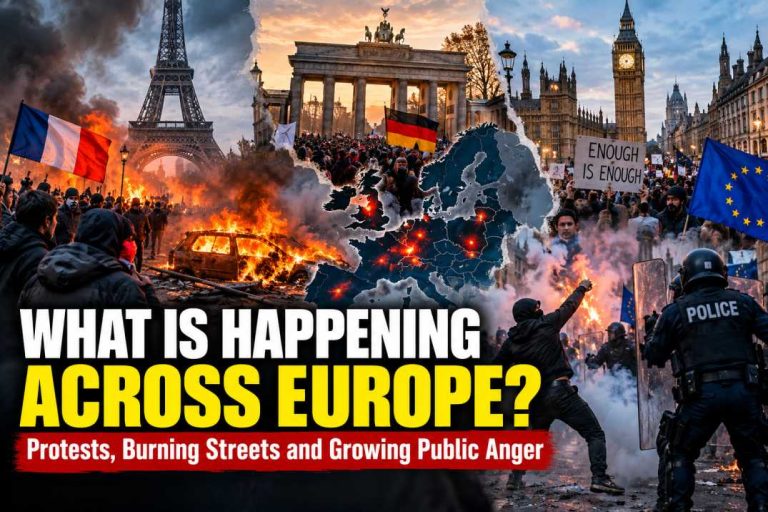
Across Europe, images of mass demonstrations, burning vehicles, clashes with police and angry crowds have sparked questions about what is happening to the continent. Videos circulating on social media show scenes of unrest, while reports of protests over living costs, housing, government policies and immigration continue to fuel public debate.
But what lies behind these events? Are Europeans losing confidence in their governments? Is immigration at the centre of the unrest? And what does this mean for the millions of immigrants who have made Europe their home?
The reality is complex. Different countries are experiencing different challenges, and not every protest has the same cause. Understanding these developments requires looking beyond viral videos to the issues people are raising and the circumstances surrounding each demonstration.
Why Are People Protesting Across Europe?
There is no single explanation for the demonstrations taking place across European countries. Economic pressures, political disagreements, concerns about public services and debates over national policies can all contribute to public frustration.
For many households, the cost of maintaining a reasonable standard of living has become a major concern. Rent, food, energy, transportation and other essential expenses can put considerable pressure on people, particularly those on lower incomes.
Housing is another major issue in several European cities. Young people and working families may struggle to find affordable accommodation, even when they have jobs. When citizens believe that working hard is no longer enough to secure a stable future, frustration can grow.
Public services also play a role. Disagreements over education, healthcare, pensions and government spending can bring students, workers and other groups into the streets.
In some countries, demonstrations are also driven by concerns about corruption, political accountability and the direction of government policy.
These issues can overlap, creating an atmosphere in which a protest that begins around one specific demand develops into a broader expression of dissatisfaction.
Immigration Has Become a Major Political Debate
Immigration remains one of Europe’s most debated political issues. Governments continue to face questions about asylum applications, border management, integration, labour shortages and the long-term effects of migration on local communities.
Some citizens want stricter immigration controls, while others argue that migration supports economic growth, helps address labour shortages and contributes to cultural diversity.
These competing views have influenced elections, political campaigns and public demonstrations in several European countries.
However, it is important to distinguish protests specifically organised around immigration from demonstrations about housing, wages, education or other public concerns. Not every protest is an anti-immigration demonstration, and not every person participating in a protest shares the same political views.
Immigration can be part of the wider political debate without being the direct cause of every incident of unrest.
Governments must address legitimate concerns about public services, integration and migration management using evidence and effective policies. At the same time, blaming entire immigrant communities for complex economic and social problems risks deepening divisions rather than solving them.
Why Are There Images of Burning Vehicles and Clashes?
Images of burning vehicles, damaged property and confrontations with police are often the most widely shared parts of a protest. They are dramatic, emotional and likely to attract attention online.
But these scenes do not necessarily represent everyone who participated in a demonstration.
Many protests begin as peaceful gatherings organised around specific political, economic or social demands. Violence may occur when tensions escalate, when individuals engage in vandalism or arson, or during confrontations between demonstrators and law enforcement.
Every incident needs to be assessed on its own evidence. It is important to establish what happened, where it occurred, what triggered the confrontation and whether the footage circulating online accurately represents the event.
Violence can put demonstrators, police officers, residents, emergency workers and business owners at risk. It can also distract from the issues that brought people into the streets in the first place.
Peaceful protest remains an important democratic right, but burning buildings, attacking people and destroying businesses can cause serious harm.
Are Europeans Losing Trust in Their Governments?
Public demonstrations can indicate that some citizens are dissatisfied with political decisions or feel that their concerns are not being addressed.
When people repeatedly raise concerns about living costs, housing, employment or public services without seeing improvements, frustration can deepen. Some may turn to protest because they believe other channels have failed to deliver meaningful change.
Political distrust can also grow when citizens believe leaders are disconnected from everyday realities or that public resources are not being managed effectively.
Nevertheless, a large demonstration does not automatically mean that an entire population has lost faith in its government. Protesters represent people with particular grievances, and their demands may differ considerably from those of other citizens.
The important question for governments is whether they can respond constructively, explain their decisions, protect democratic freedoms and address the underlying problems.
What Does This Mean for Immigrants Living in Europe?
For immigrants, scenes of unrest and increasingly heated debates about migration can create uncertainty about the future.
People who have moved to Europe for work, education, family reunification or safety may wonder whether public anger will affect their opportunities or their ability to remain in the country.
These concerns are understandable, but protests alone do not establish that immigration rules are about to change or that immigrants will be required to leave.
Immigration policies differ between European countries. Decisions about visas, residence permits, asylum and citizenship are made through national laws and official procedures, not simply through the presence of demonstrations.
Immigrants should therefore rely on official government announcements rather than assuming that viral videos signal an immediate change in their legal status.
It is also important to remember that immigrants are not a single group. They include healthcare workers, students, entrepreneurs, researchers, skilled professionals, caregivers and people working in many other sectors. Their circumstances and contributions vary, just as the views of European citizens vary.
A constructive debate should recognise both the challenges governments must manage and the rights and dignity of people who live and work in their communities.
Can Europe Address These Challenges Without More Division?
Addressing the causes of public anger requires more than responding to demonstrations after tensions have escalated.
Governments may need to examine housing affordability, wage growth, employment opportunities, public-service capacity, migration procedures and the effectiveness of integration policies.
Clear communication also matters. When governments explain their decisions honestly, publish reliable information and engage with affected communities, they can help reduce misinformation and rebuild trust.
Citizens, in turn, can participate in democratic processes, organise peaceful demonstrations, challenge policies and demand accountability without resorting to violence.
The media and social media users also have a responsibility to provide context. A video showing a fire or confrontation should not be used to make sweeping claims about an entire country, political group or immigrant population without supporting evidence.
Europe’s challenges cannot be solved by blaming one group for everything. They require serious debate, reliable information and policies that respond to the realities people face.
Is Europe Facing a Crisis?
The protests and reports of unrest deserve attention, but it would be premature to describe every European country as being in the same crisis.
Some communities are experiencing serious economic pressure and political tension. Others may be dealing with specific disputes that have little connection to events elsewhere.
Europe is not one uniform society. Its countries have different economies, immigration systems, political institutions and public priorities.
The most useful approach is to examine each event individually, understand its causes and assess whether governments are addressing the problems being raised.
The scenes appearing online may reveal genuine frustration, but they do not tell the whole story of a continent.
A Question the World Should Be Asking
Perhaps the most important question is not simply why people are taking to the streets, but what happens when citizens feel that the systems meant to serve them are no longer meeting their expectations.
People want security, affordable housing, fair opportunities, functioning public services and confidence in their future. These concerns exist in Europe and in many other parts of the world.
The challenge is to address them without turning economic hardship into hostility between communities or allowing political disagreements to become violence.
For immigrants and citizens alike, the future depends partly on whether governments can build societies in which people feel heard, public resources are managed responsibly and differences can be debated without sacrificing human dignity.
What do you think is driving the current unrest in Europe: the cost of living, immigration debates, dissatisfaction with political leaders, or a combination of these issues?