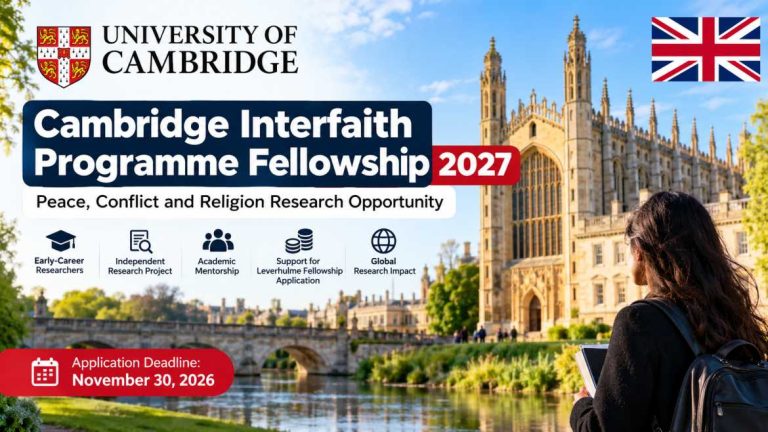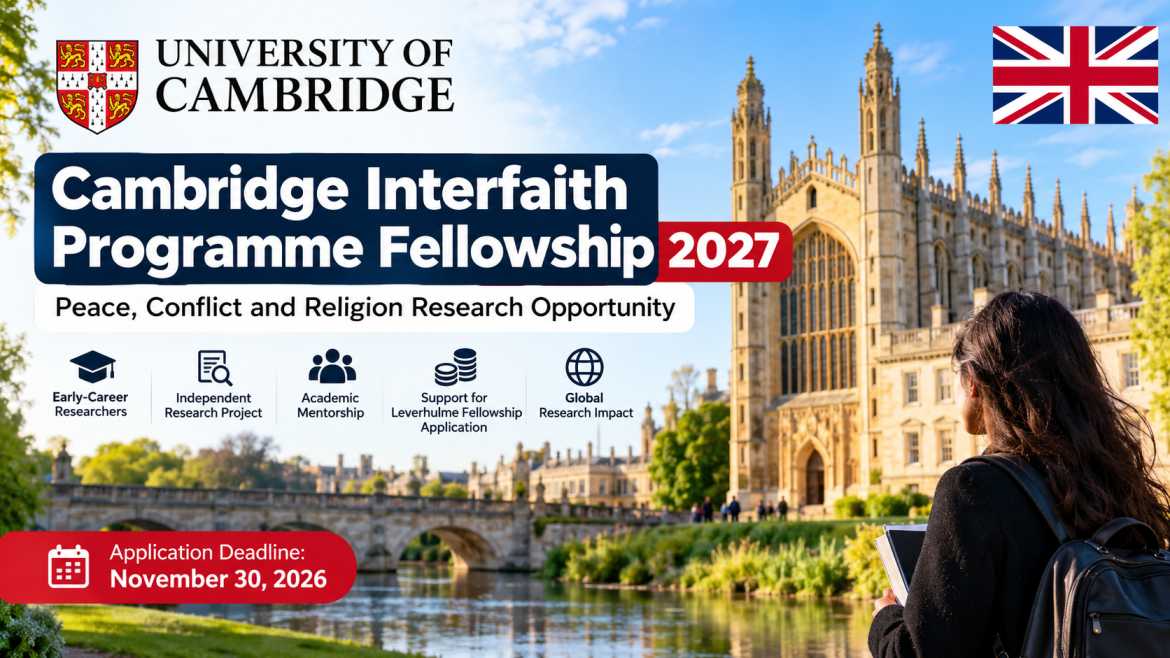
Early-career researchers interested in religion, peacebuilding, political violence, and conflict resolution can apply for a research opportunity at the Cambridge Interfaith Programme (CIP), University of Cambridge, United Kingdom.
The programme invites outstanding researchers to develop independent research proposals exploring the relationship between religion, conflict, peace, and social transformation. Successful candidates will receive academic guidance and support to prepare an application for the Leverhulme Early Career Fellowship, a competitive research funding scheme designed to support substantial academic projects.
Based within the University of Cambridge’s Faculty of Divinity, the Cambridge Interfaith Programme encourages interdisciplinary research and constructive engagement between religious communities and wider society.
The opportunity is particularly relevant to researchers who have completed, or are close to completing, their PhD and want to establish an independent research career.
Application deadline: November 30, 2026.
Applicants should note that selection by the Cambridge Interfaith Programme does not automatically guarantee the Leverhulme fellowship or its funding.
Cambridge Interfaith Programme Fellowship 2027: Overview
- Host Institution: University of Cambridge
- Research Programme: Cambridge Interfaith Programme (CIP)
- Location: Cambridge, United Kingdom
- Faculty: Faculty of Divinity
- Opportunity Type: Early-career research fellowship application support
- Research Duration: The Leverhulme Early Career Fellowship supports research for three years
- Eligible Applicants: Qualified early-career researchers who meet the applicable Leverhulme scheme requirements
- Research Focus: Religion, peacebuilding, conflict, political violence, and social transformation
- Preferred Research Geography: The Middle East and related regions are particularly encouraged
- Application Deadline: November 30, 2026
- Funding: Potential fellowship funding, subject to selection by the Leverhulme Trust and the applicable match-funding arrangements
- Official Website
About the Cambridge Interfaith Programme
The Cambridge Interfaith Programme is based in the Faculty of Divinity at the University of Cambridge. It promotes research into religion, interfaith engagement, and the relationships between religious traditions and contemporary social challenges.
Its research agenda for 2026–2031 explores how peace is created, experienced, contested, and sustained in societies affected by conflict and political violence.
Researchers are encouraged to investigate how individuals and communities respond to violence, understand justice, preserve memories of conflict, and draw on religious, cultural, and ethical traditions to pursue peaceful social change.
The programme takes an interdisciplinary approach, allowing scholars to examine these issues through perspectives such as anthropology, history, religious studies, political analysis, and related interpretive disciplines.
For the 2027 fellowship opportunity, CIP is seeking researchers capable of developing original projects that contribute meaningfully to existing scholarship.
Research Areas of Interest
Applicants are encouraged to develop independent proposals that connect with the programme’s research priorities.
Potential areas include:
1. Religion, violence, and justice: Research may investigate how religious and cultural traditions influence people’s experiences of violence, their understanding of justice, and their responses to oppression or resistance.
2. Peacebuilding and reconciliation: Projects may examine how communities pursue reconciliation, establish peaceful relationships, support nonviolent resistance, or rebuild social connections following conflict.
3. Religion, politics, and society: Researchers can explore how religious identities interact with political systems, social institutions, and public life, including how communities negotiate or challenge boundaries between religion and politics.
4. Collective memory and conflict narratives: This area considers how historical memories, public representations, and competing accounts of violence influence contemporary conflicts and prospects for peace.
5. Anthropology and ethnographic research: Applicants may propose ethnographic or other interpretive approaches to understanding how people experience conflict, navigate social change, and construct meaning in difficult circumstances.
6. Interfaith relations and social transformation: Projects may investigate how religious communities interact with one another and how dialogue, cooperation, or disagreement shapes social relations.
Research may cover different geographical and religious contexts. However, proposals focusing on the Middle East and related regions are particularly welcome.
Projects should primarily examine events from the 1950s onwards and demonstrate a clear contribution to existing academic research.
Eligibility Requirements
Applicants must meet the current eligibility conditions for the Leverhulme Early Career Fellowship scheme, as well as the Cambridge Interfaith Programme’s selection requirements.
1. Early-career research status: The opportunity is intended for researchers who have completed, or are close to completing, their PhD and are seeking to establish an independent research career.
It is not intended for applicants seeking funding to begin a PhD.
2. PhD submission requirements: According to the supplied announcement, candidates must have submitted their PhD thesis for viva voce examination no earlier than February 18, 2023.
Applicants who have not yet submitted their thesis must do so before February 18, 2027.
Because eligibility rules can change between funding cycles, applicants should verify these dates against the current Leverhulme Early Career Fellowship guidance before applying.
3. Connection to a UK higher education institution: The announcement notes that postdoctoral researchers without an existing connection to a UK higher education institution, through previous study or current employment, are not ordinarily eligible for Leverhulme awards.
This requirement is particularly important for international applicants who completed their doctoral studies outside the United Kingdom.
4. Research relevance: Your proposed project should align with the Cambridge Interfaith Programme’s interests in religion, conflict, peacebuilding, political violence, or social transformation.
5. Academic quality: Applicants should demonstrate the ability to develop an original, well-structured research project that contributes to existing scholarship.
6. Compliance with the Leverhulme scheme: Candidates must satisfy all applicable eligibility requirements, including any rules concerning doctoral status, previous academic appointments, and other restrictions specified by the funder.
Meeting the programme’s research interests does not automatically make an applicant eligible for the Leverhulme award.
How to Apply for the Cambridge Interfaith Programme Fellowship 2027
Applications should be submitted according to the Cambridge Interfaith Programme’s official instructions.
VISIT OFFICIAL WEBSITE TO APPLY
Check other opportunities:
2027 Sir Cyril Taylor Young African Leaders Program (Fully Funded)
HENNGE Global Internship 2027 in Japan (Fully Funded)
How to Apply for a Canada Visa in 2026: Study, Visit, Work and Permanent Residence
Heinrich Böll Foundation Internship 2027 in the USA: $700 Monthly Stipend and J-1 Visa Sponsorship
Stanford Fisher Family Summer Program 2027 in the USA (Fully Funded Fellowship)
WHO Summer School 2027 in France: Free Training Programme in Nice
LPI Summer Internship 2027 in the USA | Fully Funded Undergraduate Research Opportunity
France Excellence Eiffel Scholarship 2027 (Fully Funded)
Impact AI Fellowship 2027 in Germany (Get €5,000 Stipend)
CrossCulture Program 2027 in Germany (Fully Funded)
Raisina Young Fellows Programme 2027 in India (Fully Funded)