Canada has introduced new Express Entry immigration categories for 2026 as the country adjusts its economic immigration system to focus on workers, professionals and skilled candidates who can help address labour shortages and support economic growth.
For people planning to immigrate to Canada, the 2026 Express Entry system is particularly important because Immigration, Refugees and Citizenship Canada (IRCC) has introduced new category-based selection priorities while continuing several existing categories.
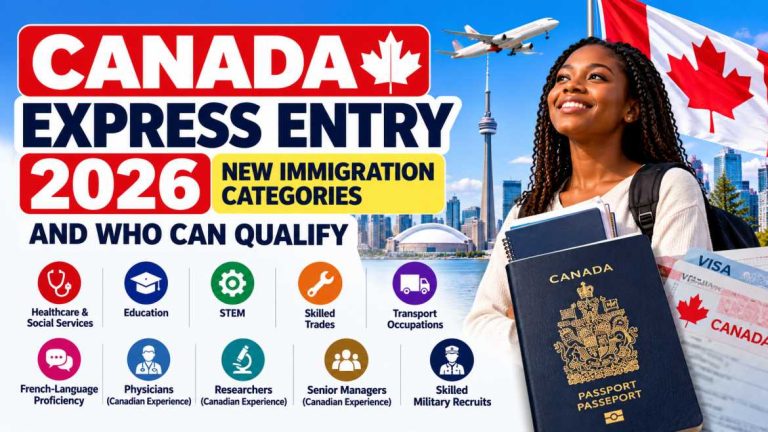
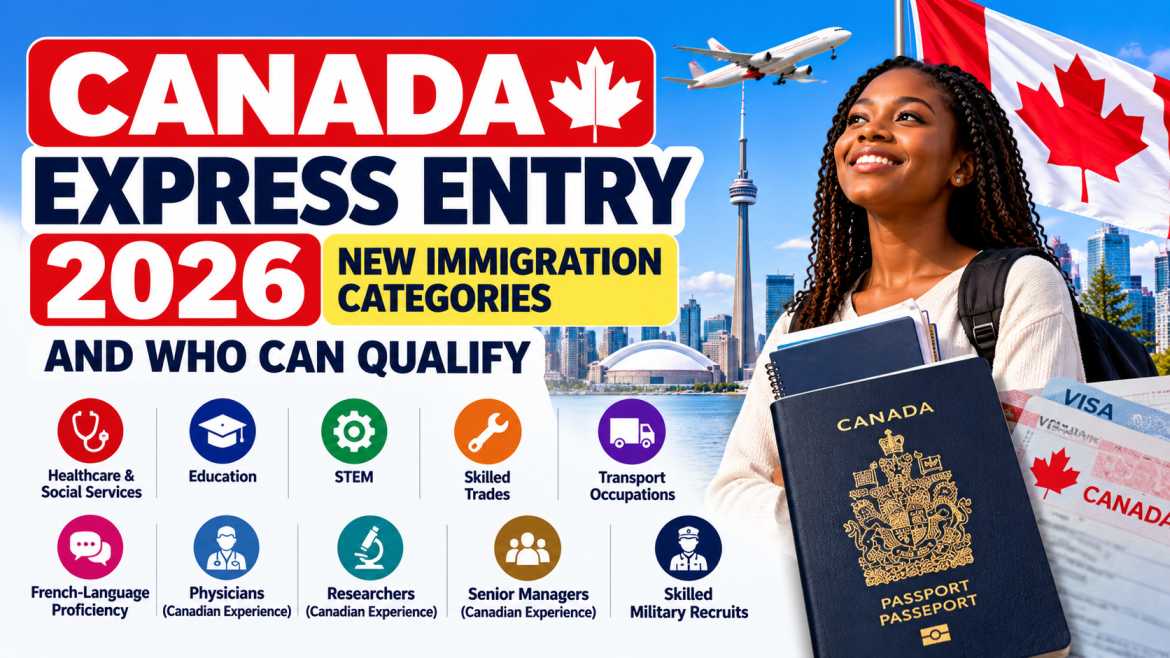
The 2026 categories include healthcare and social services, education, STEM, skilled trades, transport, French-language proficiency, physicians with Canadian work experience, researchers with Canadian work experience, senior managers with Canadian work experience and skilled military recruits.
However, being employed in an eligible occupation does not automatically guarantee permanent residence. Candidates must first qualify for one of the Express Entry programs, enter the Express Entry pool and then meet the requirements of the particular category and invitation round.
What Is Canada Express Entry?
Express Entry is Canada’s online immigration application management system for several economic immigration programs.
It is used to manage applications for:
- Federal Skilled Worker Program
- Federal Skilled Trades Program
- Canadian Experience Class
Eligible candidates create an Express Entry profile and are placed into a pool. Their profiles are assessed using the Comprehensive Ranking System, commonly called CRS.
IRCC then conducts invitation rounds and invites selected candidates to apply for permanent residence.
There are different types of Express Entry draws, including general rounds, program-specific rounds and category-based rounds.
Category-based selection allows Canada to invite candidates who meet specific economic or labour-market priorities.
What Has Changed in Express Entry for 2026?
The biggest change is the introduction of several new categories targeting specific groups of workers and professionals.
For 2026, Canada introduced categories for:
- Physicians with Canadian work experience
- Researchers with Canadian work experience
- Senior managers with Canadian work experience
- Transport occupations
- Skilled military recruits
Canada is also continuing categories covering:
- French-language proficiency
- Healthcare and social services occupations
- Education occupations
- STEM occupations
- Trade occupations
For the renewed occupation-based categories, the minimum work experience requirement has increased to at least one year of eligible experience acquired during the previous three years.
The experience can generally be obtained in Canada or abroad for the occupation-based categories, although some of the new categories specifically require Canadian work experience.
Canada Express Entry 2026 Categories
There are 10 Express Entry categories being used for 2026.
Understanding each category is important because the requirements are different.
1. French-Language Proficiency Category
Canada continues to use French-language proficiency as an Express Entry category in 2026.
To qualify for this category, candidates must have French-language test results showing at least NCLC 7 in all four language abilities:
- Speaking
- Listening
- Reading
- Writing
Candidates must also satisfy the requirements specified in the instructions for the particular invitation round.
This category is especially relevant to French-speaking applicants who want to immigrate to Canada and are considering opportunities outside Quebec.
Candidates should obtain an approved French-language test and make sure the results remain valid when required.
2. Healthcare and Social Services Occupations
Healthcare and social services remain one of Canada’s major Express Entry priorities for 2026.
Candidates in eligible occupations need at least 12 months of full-time work experience, or an equivalent amount of part-time experience, during the previous three years.
The experience does not have to be continuous.
Eligible occupations include a range of healthcare and social service professionals.
Examples include:
- Registered nurses and registered psychiatric nurses
- Nurse practitioners
- Physicians
- Dentists
- Pharmacists
- Psychologists
- Chiropractors
- Physiotherapists
- Occupational therapists
- Medical laboratory technologists
- Medical laboratory assistants
- Social workers
- Licensed practical nurses
- Dental hygienists and dental therapists
- Other occupations listed by IRCC
Applicants should check the official National Occupational Classification code and the current category list because eligibility depends on the occupation and actual duties performed.
3. Education Occupations
Education professionals are another group included in Canada’s 2026 Express Entry categories.
Candidates must generally have at least one year of qualifying work experience in an eligible occupation during the previous three years.
The experience may be full-time or an equivalent amount of part-time work.
Eligible occupations include:
- Secondary school teachers
- Elementary school and kindergarten teachers
- Early childhood educators and assistants
- Instructors of persons with disabilities
- Elementary and secondary school teacher assistants
For regulated professions such as teaching, applicants should also understand that immigration eligibility and the ability to practise the profession in a particular Canadian province are separate matters.
A person may qualify for immigration while still needing provincial licensing, certification or registration before working in a regulated occupation.
4. STEM Occupations
Canada is continuing its STEM category in 2026 to attract workers in science, technology, engineering and mathematics-related occupations.
Candidates generally need at least 12 months of full-time work experience, or an equivalent amount of part-time experience, in an eligible occupation during the previous three years.
Examples of eligible STEM occupations include:
- Architecture and science managers
- Cybersecurity specialists
- Civil engineers
- Mechanical engineers
- Electrical and electronics engineers
- Industrial and manufacturing engineers
- Geological engineers
- Civil engineering technologists and technicians
- Mechanical engineering technologists and technicians
- Electrical and electronics engineering technologists and technicians
- Insurance agents and brokers
The complete occupation list should always be checked against the current IRCC category instructions before applying.
5. Skilled Trades Category
Skilled trades remain an important part of Canada’s economic immigration strategy.
The 2026 Express Entry trade category generally requires at least 12 months of qualifying work experience in an eligible occupation during the previous three years.
Eligible occupations include trades such as:
- Construction estimators
- Construction managers
- Home building and renovation managers
- Machinists
- Sheet metal workers
- Welders
- Electricians
- Industrial electricians
- Plumbers
- Gas fitters
- Carpenters
- Cabinetmakers
- Bricklayers
- Construction millwrights and industrial mechanics
- Heavy-duty equipment mechanics
- Heating, refrigeration and air conditioning mechanics
- Electrical mechanics
- Water well drillers
- Concrete finishers
- Roofers and shinglers
- Painters and decorators
- Oil and gas drilling supervisors
- Retail and wholesale butchers
This category may be particularly relevant to candidates with practical trade experience who are exploring Canadian permanent residence.
Applicants should confirm the NOC code and make sure their actual employment duties correspond with the occupation selected.
6. Transport Occupations
Transport is one of the new Express Entry categories introduced for 2026.
The category targets workers with experience in selected transport occupations.
Examples include:
- Aircraft mechanics and aircraft inspectors
- Air pilots, flight engineers and flying instructors
- Aircraft instrument, electrical and avionics mechanics, technicians and inspectors
- Automotive service technicians
- Truck and bus mechanics
- Mechanical repairers
Candidates generally need at least 12 months of qualifying work experience in an eligible occupation during the previous three years.
Some transport occupations can involve professional licences or regulatory requirements, so immigration eligibility should not be confused with authorization to work in a particular Canadian province or territory.
7. Physicians With Canadian Work Experience
Canada created a new Express Entry category for physicians who have Canadian work experience.
This category is specifically designed for doctors who have already gained qualifying professional experience in Canada.
Eligible occupations include:
- Specialists in clinical and laboratory medicine
- Specialists in surgery
- General practitioners and family physicians
Applicants must have at least 12 months of qualifying Canadian work experience during the previous three years and satisfy the other requirements established for the category and invitation round.
This category is therefore different from a general overseas doctor pathway. A physician outside Canada should not assume that having a medical degree alone makes them eligible for this particular Express Entry category.
8. Researchers With Canadian Work Experience
Researchers with Canadian work experience are another new priority for Express Entry in 2026.
The category is aimed at retaining highly skilled research talent already contributing to Canada’s research and innovation environment.
Eligible occupations include:
- University professors and lecturers
- Post-secondary teaching and research assistants
Candidates need at least 12 months of qualifying Canadian work experience during the previous three years and must satisfy the other requirements of the applicable Express Entry round.
This category may be relevant to researchers, academics and highly skilled graduates who have obtained qualifying Canadian research experience.
9. Senior Managers With Canadian Work Experience
Canada has also introduced an Express Entry category for senior managers who have Canadian work experience.
The eligible occupations include:
- Senior managers in financial, communications and other business services
- Senior managers in health, education, social and community services and membership organizations
- Senior managers in trade, broadcasting and other services
- Senior managers in construction, transportation, production and utilities
Applicants must generally have at least 12 months of eligible Canadian work experience during the previous three years.
This category is specifically focused on candidates with Canadian experience, so simply holding a senior management position overseas does not automatically make someone eligible for this category.
10. Skilled Military Recruits
Canada has introduced another new category for highly skilled foreign military applicants.
The category is intended for eligible foreign military personnel recruited by the Canadian Armed Forces.
Applicants must meet the requirements for the Foreign Skilled Military Applicant pathway, including the applicable service, recruitment and employment conditions.
The category can include highly skilled military personnel in occupations such as:
- Military doctors
- Military nurses
- Military pilots
- Other qualifying military occupations
This is a specialized immigration route and is not the same as applying for Express Entry as a civilian worker.
Do You Need Canadian Work Experience for Express Entry in 2026?
Not necessarily.
This is one of the most important points applicants should understand.
Some of the 2026 categories specifically require Canadian work experience. These include:
- Physicians
- Researchers
- Senior managers
However, several occupation-based categories allow qualifying experience acquired in Canada or abroad.
These include:
- Healthcare and social services
- STEM
- Trades
- Education
- Transport
The French-language category is based primarily on language proficiency and the other requirements specified in the invitation instructions.
Separately, Express Entry continues to include programs with their own eligibility requirements, including the Federal Skilled Worker Program, Federal Skilled Trades Program and Canadian Experience Class.
Can You Apply From Outside Canada?
Yes, depending on the Express Entry program and category.
You do not necessarily need to be physically present in Canada to create an Express Entry profile.
For example, candidates with eligible foreign work experience may potentially qualify for the Federal Skilled Worker Program and some category-based selection streams.
However, candidates should carefully distinguish between categories that accept foreign work experience and categories that specifically require Canadian work experience.
Someone living in Nigeria, Ghana, Kenya, South Africa, India, the United Kingdom or another country may potentially create an Express Entry profile if they meet the requirements of one of the participating programs.
How the Express Entry Process Works
The Express Entry process generally follows several stages.
First, determine whether you qualify for one of the Express Entry-managed programs.
Next, take the required language test and obtain an Educational Credential Assessment if applicable.
You then prepare your documents and create an Express Entry profile.
If eligible, your profile enters the Express Entry pool and receives a CRS score.
IRCC then conducts invitation rounds.
If you meet the requirements of a category-based draw, you may be considered for that category. Your CRS score still matters because candidates within an eligible category are ranked and invitations are issued to the highest-ranking candidates according to the instructions for that round.
If you receive an Invitation to Apply, you can submit your permanent residence application within the required timeframe.
What Is the CRS Score?
The Comprehensive Ranking System is the points-based system used to rank Express Entry candidates.
The CRS considers factors including:
- Age
- Education
- Language ability
- Canadian work experience
- Foreign work experience
- Skill transferability
- Spouse or common-law partner factors
- Additional points where applicable
A candidate’s CRS score can therefore be affected by improving language results, obtaining additional education, gaining qualifying Canadian experience or meeting other factors recognized under the CRS.
Important Change: Job Offers No Longer Give CRS Points
One of the biggest Express Entry changes applicants need to understand is the removal of CRS points for job offers.
Since March 25, 2025, IRCC no longer awards the previous 50 or 200 CRS points for qualifying job offers.
This means applicants should not calculate their 2026 Express Entry score by adding 50 or 200 points for a Canadian job offer.
However, a job offer can still matter for certain immigration programs and eligibility requirements.
For example, IRCC states that valid job offers can remain relevant to the Federal Skilled Trades Program, Federal Skilled Worker Program and certain Provincial Nominee Program streams.
Therefore, the removal of CRS job-offer points does not mean that Canadian employment offers have become irrelevant to immigration.
How to Improve Your Express Entry Profile in 2026
Candidates can focus on several areas that influence their eligibility and ranking.
Improve your language score.
Language proficiency can have a significant effect on CRS points. Candidates who speak both English and French may have additional opportunities depending on their results and eligibility.
Obtain an Educational Credential Assessment.
If you completed your education outside Canada and need an ECA for your immigration program, obtain it from an organization recognized by IRCC.
Gain relevant work experience.
Candidates should carefully document their employment history and ensure that their actual duties match the selected NOC occupation.
Consider Canadian education.
Canadian education can contribute to CRS points and may provide access to other immigration pathways depending on the circumstances.
Explore French.
French-language proficiency has its own Express Entry category in 2026. Applicants who can achieve the required NCLC level may benefit from being eligible for French-language category-based selection.
Keep documents updated.
Language tests, passports, police certificates and other documents can have validity periods. Applicants should monitor expiry dates and ensure their information remains accurate.
Who Can Benefit From the 2026 Express Entry Categories?
The 2026 system can be relevant to a wide range of candidates.
For example, an experienced nurse with the required work history may look at the healthcare and social services category.
A qualified carpenter, plumber, electrician or welder may examine the trades category.
A cybersecurity specialist or engineer may investigate the STEM category.
A teacher or early childhood educator may look at the education category.
A pilot or aircraft mechanic may review the transport category.
A French-speaking professional who meets the language threshold may consider the French-language category.
A researcher already working in Canada may examine the new researcher category.
A senior manager with qualifying Canadian experience may consider the senior-manager category.
A physician who has already accumulated eligible Canadian work experience may review the physician category.
The important point is that each candidate must satisfy the specific requirements rather than relying only on their job title.
Can a Job in an Eligible Occupation Guarantee Permanent Residence?
No.
Working in an occupation listed under an Express Entry category does not automatically result in permanent residence.
The applicant must still:
- Qualify for an Express Entry-managed immigration program.
- Create an Express Entry profile.
- Enter the Express Entry pool.
- Meet the requirements of the applicable category.
- Have a competitive ranking under the applicable invitation round.
- Receive an Invitation to Apply.
- Submit a complete permanent residence application.
- Meet Canada’s admissibility requirements.
Category-based selection is an additional way IRCC selects candidates. It does not remove the basic Express Entry requirements.
What CRS Score Do You Need for Canada Express Entry in 2026?
There is no single CRS score that guarantees an invitation for every Express Entry candidate.
The required score changes according to the type of draw, the number of invitations issued, the candidates in the pool and the instructions established for that particular round.
For example, IRCC reported a healthcare and social services category draw on September 4, 2026, that issued 3,500 invitations and had a lowest-ranked invited candidate CRS score of 475.
Earlier Canadian Experience Class draws also had different cut-offs.
This demonstrates why applicants should not rely on an old Express Entry CRS cut-off found on a website or social media post.
The relevant draw date, category and candidate population must always be considered.
Express Entry 2026 and Provincial Nominee Programs
Provincial Nominee Programs can also play an important role in Canada’s economic immigration system.
A province or territory can nominate candidates who meet its own labour-market and settlement requirements.
Some provincial nominations are connected to Express Entry.
A provincial nomination can provide a substantial CRS advantage under the current system, although applicants must first meet the requirements of the relevant provincial stream.
Candidates should therefore consider both federal Express Entry and provincial immigration opportunities when planning their Canadian immigration strategy.
What About People With Low CRS Scores?
A low CRS score does not necessarily mean that every Canadian immigration option is closed.
Candidates can examine ways to improve their ranking or investigate other immigration programs.
Possible options can include:
- Improving English or French test results
- Gaining additional qualifying work experience
- Obtaining Canadian education
- Exploring Provincial Nominee Programs
- Checking regional immigration programs
- Looking at Atlantic immigration pathways
- Exploring employer-supported immigration where applicable
- Investigating category-based selection
- Developing French-language skills
- Reviewing other federal or provincial economic programs
The most appropriate route depends on the candidate’s age, education, occupation, work history, language ability, finances, family situation and other eligibility factors.
Does Canada Still Invite Foreign Workers in 2026?
Yes.
Canada continues to use Express Entry to select economic immigrants, while its category-based system is designed to target specific labour-market needs.
The 2026 approach places significant attention on candidates with Canadian work experience, French-language proficiency and experience in priority occupations such as healthcare, STEM, trades, education and transport.
At the same time, some category-based pathways allow qualifying work experience obtained outside Canada.
How to Check Your Eligibility for Express Entry
The safest way to determine eligibility is to use the official IRCC requirements rather than relying on social media posts or unofficial calculators.
Start by determining which Express Entry program you may qualify for.
Then check:
- Your age
- Education
- Language test results
- Work experience
- NOC occupation
- Canadian work history
- French-language ability
- Proof of funds where required
- Admissibility
- Provincial nomination possibilities
After that, calculate your CRS score using the official IRCC system.
Documents You May Need
Express Entry applicants may need several documents throughout the process.
These can include:
- Valid passport
- Language test results
- Educational Credential Assessment
- Educational certificates
- Academic transcripts
- Employment reference letters
- Proof of work experience
- Police certificates
- Proof of funds where required
- Medical examination results
- Civil-status documents
- Provincial nomination documents where applicable
- Other documents requested by IRCC
Applicants should avoid submitting inaccurate employment information or selecting a NOC code simply because its title sounds similar to their job.
IRCC assesses the duties performed, not just the job title.
Canada Express Entry 2026 for Nigerians and Other African Applicants
Applicants from Nigeria and other African countries can use Express Entry if they satisfy the relevant immigration requirements.
There is no general rule that prevents Nigerians, Ghanaians, Kenyans, South Africans or other African nationals from entering the Express Entry pool.
Applicants educated outside Canada will usually need to follow the applicable education assessment requirements, while language testing is an important part of the process.
For regulated professions such as nursing, medicine, teaching and certain engineering occupations, applicants should also understand the difference between immigration eligibility and professional licensing.
Being eligible for Canadian permanent residence does not automatically provide a licence to practise a regulated profession.
Canada Express Entry 2026: Key Takeaways
The 2026 Express Entry system contains 10 category-based selection priorities.
The five continuing occupation and language categories are:
- French-language proficiency
- Healthcare and social services
- Education
- STEM
- Trades
The new or expanded priorities include:
- Physicians with Canadian work experience
- Researchers with Canadian work experience
- Senior managers with Canadian work experience
- Transport occupations
- Skilled military recruits
For the renewed occupation-based categories, candidates generally need at least one year of qualifying experience in an eligible occupation during the previous three years.
Some new categories require Canadian work experience, so overseas applicants should carefully check whether their experience meets the particular category’s requirements.
Applicants should also remember that Express Entry remains competitive. Meeting a category requirement does not guarantee an Invitation to Apply.
Frequently Asked Questions
What are the new Express Entry categories for 2026?
The new categories include physicians with Canadian work experience, researchers with Canadian work experience, senior managers with Canadian work experience, transport occupations and skilled military recruits.
What Express Entry categories continue in 2026?
Canada continues French-language proficiency, healthcare and social services, education, STEM and trade occupations as category-based selection priorities.
Can I apply for Express Entry from outside Canada?
Yes. Some Express Entry programs and categories accept qualifying foreign work experience, although certain categories specifically require Canadian work experience.
How much work experience is required for the 2026 category-based draws?
For the renewed occupation-based categories, candidates generally need at least 12 months of qualifying full-time work experience, or an equivalent amount of part-time experience, during the previous three years.
Do I need a job offer for Express Entry?
Not necessarily. A job offer is not required for every Express Entry program. In addition, IRCC removed CRS points for job offers in March 2025. However, a valid offer can still matter for certain eligibility requirements.
Does a job offer give 50 CRS points in 2026?
No. IRCC removed the previous CRS points for job offers as of March 25, 2025.
Can a nurse apply through Express Entry?
A nurse may potentially qualify through an Express Entry program and may also fall within the healthcare and social services category if the applicable requirements are met.
Can teachers apply through Express Entry in 2026?
Certain teachers and education professionals are included in the 2026 education category. They must still satisfy the applicable Express Entry program and category requirements.
Can welders and electricians apply for Canadian permanent residence through Express Entry?
Certain welders, electricians and other skilled trades workers are included in the 2026 trade category. Applicants must meet the required work experience and Express Entry program conditions.
Can French speakers apply for Express Entry?
Yes. Candidates with French-language test results meeting the required NCLC 7 level in all four abilities can potentially qualify for the French-language category, provided they meet the other requirements.
Is Express Entry guaranteed if my occupation is on the list?
No. An eligible occupation does not guarantee an Invitation to Apply. Candidates must qualify for an Express Entry program, enter the pool and meet the requirements of the relevant invitation round.
What is the minimum CRS score for Express Entry in 2026?
There is no permanent minimum CRS cut-off for all Express Entry applicants. The score varies between invitation rounds and categories.
Can I immigrate to Canada without Canadian work experience?
Yes, depending on the immigration program and category. Some pathways recognize eligible foreign work experience.
Can I apply for Express Entry without IELTS?
You need an approved language test that meets the requirements of your immigration program. English applicants commonly use an approved English test, while French applicants can use an approved French test. The exact test and minimum score depend on the program.
What happens after receiving an Invitation to Apply?
After receiving an Invitation to Apply, the candidate must submit the permanent residence application and supporting documents within the deadline specified by IRCC. The information provided must be accurate and supported by appropriate documentation.
Official Canada Express Entry Resources
Applicants should always verify current requirements directly through the Government of Canada.
OFFICIAL CANADA EXPRESS ENTRY WEBSITE
2026 EXPRESS ENTRY CATEGORY-BASED SELECTION
EXPRESS ENTRY ROUNDS OF INVITATIONS
FEDERAL SKILLED WORKER PROGRAM
Check other opportunities:
Erasmus Mundus GLOCAL Scholarship 2027/29 in Europe — Fully Funded
Study in the UK with the Cambridge Mastercard Scholarship
Global Leadership Challenge 2026 in Switzerland: Fully Funded St. Gallen Symposium Opportunity
Emirates Cabin Crew Jobs 2026 in Dubai – Salary, Benefits and How to Apply
Paris Peace Forum 2026 YAS Delegation: Apply to Join the #YouthTrack in France
South African State Theatre Videographer Internship 2026: 12-Month Creative Opportunity
Italian Innovation Challenge 2026: Fully Funded Trip to Rome, Italy