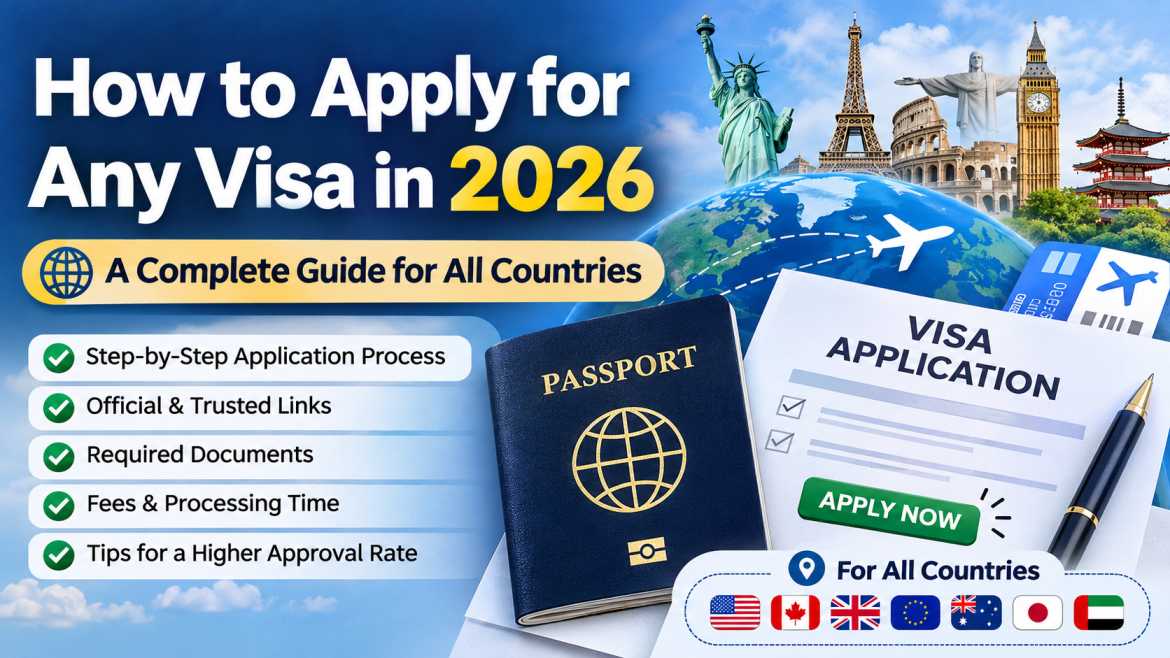
Are you planning to travel abroad in 2026 but don’t know how to apply for a visa? Whether you want to visit the United States, Canada, the United Kingdom, Germany, France, Australia, Japan, Hungary, South Africa, Dubai or any other country, understanding the visa application process is the first step towards a successful journey.
Applying for a visa can seem complicated, especially if you have never travelled internationally or previously handled a visa application yourself. Different countries have different immigration policies, application procedures, eligibility requirements, processing times and fees. Some countries allow applicants to complete the entire process online, while others require applicants to visit an embassy or an authorised visa application centre for document submission and biometric enrolment.
The good news is that most visa application processes follow a similar structure. Once you understand how to identify the correct visa category, prepare your supporting documents, complete the application form, pay the applicable fees and attend your appointment, you will be better prepared to apply to different countries.
In this comprehensive 2026 guide, we explain how to apply for a visa to any country in the world, the different types of visas available, the documents you may need, how to find official visa application websites, and how to avoid common mistakes that lead to visa refusals.
We have also included direct links to official government immigration websites and visa application portals to help you get started.
Important: This guide covers the general international visa application process. It is not possible to use one application form or one website to apply for every country’s visa. Your eligibility and requirements depend on your nationality, destination, purpose of travel and personal circumstances.
1. Understand What a Visa Is
A visa is an official authorisation issued by a country that allows a foreign national to travel to its territory for a specified purpose and under certain conditions.
Depending on the country, a visa may be issued as a sticker in your passport, an electronic visa (eVisa), an electronic travel authorisation (ETA) or another form of entry permission.
A visa does not always guarantee entry into a country. Immigration officials at the border may still ask questions and determine whether you meet the entry requirements.
For example, someone travelling from Nigeria to Canada may need a Canadian visitor visa, while someone travelling from Nigeria to Kenya needs to check Kenya’s Electronic Travel Authorisation requirements.
Before applying for any visa, you should establish whether your nationality requires a visa or whether you qualify for visa-free entry, an eVisa, an ETA or visa on arrival.
2. Identify the Type of Visa You Want to Apply For
The first step in any visa application is identifying the correct visa category.
Countries issue different visas depending on why someone wants to enter their territory. Applying for the wrong category can lead to refusal or immigration complications.
Here are some of the most common visa categories.
A. Tourist or Visitor Visa
A tourist visa is designed for people who want to visit another country temporarily for holidays, sightseeing, visiting friends or family, or other permitted visitor activities.
Examples include:
- UK Standard Visitor Visa.
- Canada Visitor Visa.
- US B1/B2 Visitor Visa.
- Schengen Tourist Visa.
- Australian Visitor Visa.
- Japan Temporary Visitor Visa.
Applicants may be required to demonstrate that they can finance their visit, have a genuine reason for travelling and intend to comply with the conditions of their stay.
B. Student Visa
A student visa is issued to international students who have been accepted into an eligible educational institution.
Depending on the country, you may need:
- An admission or acceptance letter.
- Proof of tuition payment or funding.
- Evidence of sufficient financial resources.
- Academic certificates and transcripts.
- English language test results, where required.
- Medical examination results, where applicable.
- Evidence of accommodation.
Examples include Canada’s study permit, the UK’s Student Visa, Australia’s Student Visa and Germany’s national student visa.
C. Work Visa
A work visa allows eligible foreign nationals to work legally in another country.
Some work visas require an employment offer from an employer who is authorised to hire foreign workers. Other immigration programmes may allow eligible applicants to apply based on their qualifications, skills, investment or other criteria.
Examples include:
- UK Skilled Worker Visa.
- Canada employer-specific work permit.
- Germany skilled worker visa.
- Australia Skills in Demand visa.
- New Zealand Accredited Employer Work Visa.
Before applying, establish whether you need a job offer, employer sponsorship, a work permit, professional registration or a recognised qualification.
D. Business Visa
A business visa is intended for people travelling for permitted business activities, such as attending meetings, conferences, trade exhibitions or negotiating business arrangements.
It does not automatically authorise you to take up employment in the destination country.
E. Family Visit Visa
This visa allows eligible people to visit family members who are living in another country.
Depending on the destination, you may need an invitation letter, proof of your relationship, the host’s immigration status and evidence of accommodation or financial support.
F. Family Reunification or Dependant Visa
This category allows eligible family members to join a person who is legally living, studying or working in another country.
Requirements vary significantly. Some countries allow spouses and children to accompany work or student visa holders, while others impose additional income, employment or qualification conditions.
G. Transit Visa
A transit visa may be required when you pass through a country on your way to another destination.
Whether you need one depends on your nationality, airport, length of transit, terminal arrangements and whether you intend to leave the international transit area.
H. Medical Visa
A medical visa is issued to eligible people travelling abroad to receive medical treatment.
Applicants may need a medical appointment confirmation, a letter from the receiving hospital, treatment details and evidence of funding.
I. Permanent Residency and Immigration Visas
These are intended for people who want to settle permanently in another country.
Examples include:
- Canada’s Express Entry and eligible provincial immigration pathways.
- Australia’s skilled migration programmes.
- New Zealand residence pathways.
- Germany’s eligible employment and settlement pathways.
- Family-based immigration programmes in different countries.
These are generally more complex than ordinary visitor visas and may involve eligibility assessments, skills evaluations, sponsorship or other requirements.
Important: Never apply for a tourist visa when your actual intention is to work or study if the destination’s immigration rules do not permit those activities under that visa.
3. Check Whether You Need a Visa Before Applying
Not everyone needs a visa to visit every country.
Visa requirements are determined by several factors, including:
- Your nationality.
- The passport you hold.
- The country you intend to visit.
- Your purpose of travel.
- How long you intend to stay.
- Your immigration status in your current country of residence.
- Your travel route and transit arrangements.
For example, a Nigerian passport holder may require a visa to visit a country where a British passport holder can travel without one.
Similarly, some nationalities can enter certain countries with an eVisa, while others must apply through an embassy.
How to check your visa requirements
You can start with the following international travel information resource:
IATA Travel Centre: https://www.iata.org/en/travel-centre/
The International Air Transport Association (IATA) provides passport, visa and health requirement information using a database that draws on information from official sources worldwide. It is particularly useful for checking travel documentation before booking a flight. However, it is an information resource, not a government visa application portal. Confirm the final requirements with the destination country’s immigration authority.
You should also visit the destination country’s official immigration website or embassy website to confirm the latest requirements.
4. Find the Official Visa Application Website
After confirming that you need a visa, the next step is finding the correct website to apply.
This is one of the most important stages because there are many unofficial websites online that offer visa application assistance, sometimes charging additional fees.
Some are legitimate service providers, while others may mislead applicants into believing they are government websites.
The safest approach is to begin with the official immigration department, foreign affairs ministry or embassy website of your destination country.
Some countries operate their own online visa portals. Others outsource the collection of applications and biometrics to authorised service providers such as VFS Global, TLScontact or BLS International.
Remember that these companies do not make the final visa decision. That responsibility belongs to the relevant immigration authority or diplomatic mission.
Here are verified official starting points for some of the world’s most popular destinations.
Official visa application websites for popular countries in 2026
1. United Kingdom
https://www.gov.uk/browse/visas-immigration
The UK government provides information about visitor, student, work, family and settlement visas.
For a Standard Visitor Visa, applicants can use:
https://www.gov.uk/standard-visitor/apply-standard-visitor-visa
The application is completed online, followed by an appointment at an authorised visa application centre where required. Applicants must check their eligibility and the activities permitted under the visa category.
2. Canada
https://www.canada.ca/en/immigration-refugees-citizenship.html
Canada’s Immigration, Refugees and Citizenship Canada (IRCC) website provides information about visitor visas, study permits, work permits, permanent residency and family sponsorship.
For a Canadian visitor visa:
For study permits:
https://www.canada.ca/en/immigration-refugees-citizenship/services/study-canada/study-permit.html
For work permits:
https://www.canada.ca/en/immigration-refugees-citizenship/services/work-canada/permit.html
3. United States of America
Official website:
https://travel.state.gov/content/travel/en/us-visas.html
The US Department of State provides information about visitor, student, exchange, employment and immigrant visa categories.
For non-immigrant visa applications, applicants generally complete the DS-160 form:
To identify the appropriate visa category, use the official Visa Wizard:
https://travel.state.gov/content/travel/en/us-visas/visa-information-resources/wizard.html
Visa appointment and payment instructions depend on the country where you apply. Always follow the instructions published by the relevant US Embassy or Consulate.
4. Germany
Official website:
https://www.auswaertiges-amt.de/en/visa-service
Germany offers different visa categories, including visitor, student, employment, vocational training and family reunification visas.
For certain national visas, applicants can begin their application through the Consular Services Portal:
The German government introduced this portal to enable online applications for several national visa categories. Applicants may still need to attend an in-person appointment for biometric enrolment, original document verification and other formalities.
5. France
Official visa information:
https://france-visas.gouv.fr/en
France-Visas is the official French government visa portal.
Applicants can use it to:
- Check whether they need a visa.
- Identify the appropriate visa category.
- Complete an online application.
- Review supporting document requirements.
- Find information about submitting their application.
6. Italy
Official visa information:
https://vistoperitalia.esteri.it
Italy’s official visa portal helps applicants identify the visa requirements applicable to their nationality, purpose of travel and intended duration of stay.
7. Spain
Official visa information:
Applicants should select the relevant Spanish embassy or consulate website to access visa information and local application instructions.
Depending on their country of residence, applications may be submitted through an authorised visa application centre.
8. Netherlands
Official immigration website:
For short-stay Schengen visa information:
https://www.netherlandsworldwide.nl/visa-the-netherlands
9. Australia
Official immigration website:
https://immi.homeaffairs.gov.au
Australia uses its online ImmiAccount platform for many visa applications.
Applicants can explore visitor, student, skilled migration, employer-sponsored and family visa categories.
ImmiAccount:
https://online.immi.gov.au/lusc/login
10. New Zealand
Official immigration website:
https://www.immigration.govt.nz
Applicants can explore visitor, student, work and residence visa options.
Online application guidance:
11. Japan
Official Ministry of Foreign Affairs website:
https://www.mofa.go.jp/j_info/visit/visa
Japan provides information about tourist, business, work, student and other visa categories.
For eligible applicants, Japan also operates an official eVisa system:
Not every nationality or country of residence qualifies for the online system. Applicants should check the current eligibility conditions before applying.
12. India
Official Indian visa website:
https://indianvisaonline.gov.in
India provides regular visa applications through its diplomatic missions and electronic visa applications for eligible nationalities and permitted categories.
Official eVisa portal:
https://indianvisaonline.gov.in/evisa
13. China
Official visa information:
Applicants should select their country or region of residence and follow the instructions for the relevant Chinese Embassy or authorised visa application centre.
14. Turkey (Türkiye)
Official government eVisa portal:
Applicants can check their eligibility and apply for an electronic visa for permitted tourism and commercial activities.
For work, study and other purposes, applicants should follow the Turkish Ministry of Foreign Affairs and embassy procedures.
15. Saudi Arabia
Official tourist eVisa portal:
The portal allows eligible nationalities to apply for Saudi tourist eVisas.
Applicants whose nationalities are not eligible for the online tourist visa should consult the nearest Saudi Embassy or Consulate.
16. United Arab Emirates (UAE)
Official UAE government visa information:
https://u.ae/en/information-and-services/visa-and-emirates-id
For entry permits and visas, the government identifies the following official application channels:
- Federal Authority for Identity, Citizenship, Customs and Ports Security (ICP): https://icp.gov.ae/
- Dubai General Directorate of Residency and Foreigners Affairs: https://www.gdrfad.gov.ae/
Some UAE visa applications are submitted through an eligible airline, hotel, travel agency or sponsor, depending on the visa category.
17. Thailand
Official eVisa portal:
The Thai Ministry of Foreign Affairs provides an online application process that includes account registration, application form completion, document uploads, payment and processing.
18. Singapore
Official Immigration and Checkpoints Authority:
Visa guidelines:
Applicants should check whether their passport requires a Singapore entry visa. Where required, applications are generally submitted through an authorised visa agent or a local contact in Singapore, depending on the applicable arrangements.
19. Kenya
Official Electronic Travel Authorisation portal:
Kenya uses an eTA system for many international visitors. Applicants should check the exemptions and requirements applicable to their nationality and travel circumstances.
20. Nigeria
Official Nigeria Immigration Service:
Nigeria’s visa categories and application procedures are published through the Nigeria Immigration Service website.
Visa information:
These are examples, not an exhaustive list of every country’s visa portal. For destinations not listed here, use the official government or embassy website rather than relying on an unverified third-party website.
5. How to Apply for a Schengen Visa in 2026
The Schengen visa is one of the most popular visa categories for travellers visiting Europe.
It allows eligible non-EU nationals to visit participating Schengen countries for short stays of up to 90 days within any 180-day period.
The Schengen Area includes countries such as:
- France.
- Germany.
- Italy.
- Spain.
- Netherlands.
- Belgium.
- Portugal.
- Switzerland.
- Sweden.
- Austria.
- Greece.
- Finland.
- Denmark.
- Norway.
- Poland.
- Hungary.
- Czech Republic.
- Croatia.
- Iceland.
The complete list and official information are available here:
https://home-affairs.ec.europa.eu/policies/schengen/visa-policy/applying-schengen-visa_en
How to apply
Step 1: Identify the main country you intend to visit.
If you are visiting multiple Schengen countries, you should generally apply through the country where you intend to spend the longest time.
If you will spend an equal number of days in multiple countries, apply through the country you intend to enter first.
Step 2: Visit the relevant embassy or official visa application website.
Step 3: Complete the Schengen visa application form.
Step 4: Prepare your supporting documents.
Step 5: Book an appointment if required.
Step 6: Attend your appointment and provide biometric information where applicable.
Step 7: Pay the applicable visa fee.
Step 8: Wait for the decision and collect your passport as instructed.
Important Schengen visa information
Under the general rules, applications should be submitted no earlier than six months before the intended journey and at least 15 days before departure.
The standard processing time is generally 15 calendar days, although it can be extended to 45 days in certain circumstances.
As of the 2026 guide publication date, the standard Schengen visa fee is €90 for adults and €45 for children aged 6–12, subject to applicable exemptions and special arrangements. Visa application centres may charge additional service fees.
Always confirm the current fee and requirements with the relevant consulate.
6. Prepare the Required Visa Application Documents
Once you have identified the appropriate visa category and application portal, the next step is preparing your documents.
Visa requirements differ between countries, but the following documents are commonly requested.
1. International Passport
Your passport is one of the most important documents in any international visa application.
Check that:
- Your passport is valid.
- It has sufficient remaining validity for your destination.
- It has available blank pages where required.
- Your personal information is accurate.
- Your passport is not damaged.
Some countries require six months of remaining passport validity, while others have different rules. Always check the specific destination’s requirements.
2. Completed Visa Application Form
Most countries require applicants to complete an official visa application form.
The form may request:
- Full name.
- Date of birth.
- Nationality.
- Passport information.
- Employment details.
- Travel history.
- Purpose of travel.
- Intended travel dates.
- Accommodation details.
- Financial information.
- Previous visa refusals.
- Family information.
Ensure that the information provided is accurate and consistent with your supporting documents.
3. Passport Photograph
Many visa applications require a recent passport photograph.
Photograph requirements may include:
- Specific dimensions.
- A plain background.
- A clear view of the face.
- No inappropriate editing.
- Compliance with the destination country’s photograph specifications.
Some online portals require applicants to upload digital photographs rather than physical copies.
4. Bank Statements and Proof of Funds
Financial documents are important for many visitor and student visa applications.
Depending on the visa category, you may need to demonstrate that you can pay for:
- Flights.
- Accommodation.
- Transportation.
- Food.
- Tuition fees.
- Medical expenses.
- Other living expenses.
Common financial documents include:
- Personal bank statements.
- Business bank statements.
- Employment income records.
- Payslips.
- Sponsorship letters.
- Scholarship award letters.
- Proof of tuition payment.
- Other verifiable evidence of financial support.
There is no universal minimum bank balance for every country. The amount required depends on the destination, duration of stay, accommodation arrangements and individual circumstances.
Do not borrow money temporarily or manipulate bank statements to create a misleading financial picture. Such practices can damage your application and potentially result in serious immigration consequences.
5. Employment or Business Documents
If you are employed, you may be asked to provide:
- Employment confirmation letter.
- Leave approval letter.
- Payslips.
- Staff identification.
- Evidence of salary payments.
If you own a business, you may provide:
- Business registration documents.
- Business bank statements.
- Tax records, where applicable.
- Evidence of business operations.
- Other relevant financial documents.
6. Accommodation Details
Depending on your visa category, you may need to show where you intend to stay.
This could include:
- Hotel reservations.
- Accommodation booking confirmations.
- A host’s invitation letter.
- Evidence of a relative’s address.
- University accommodation confirmation.
7. Travel Itinerary
A travel itinerary explains your proposed journey.
It may include:
- Intended arrival date.
- Intended departure date.
- Countries you plan to visit.
- Cities you intend to visit.
- Accommodation arrangements.
- Planned activities.
Only submit genuine and accurate travel information. Avoid purchasing non-refundable flights simply because you believe a paid ticket is required. Check the embassy’s instructions first.
8. Invitation Letter
An invitation letter may be necessary for family visits, business trips, conferences or certain other visa categories.
Depending on the country, the letter may contain:
- The host’s full name.
- Contact details.
- Residential or business address.
- Immigration status.
- Relationship with the applicant.
- Purpose of the visit.
- Proposed duration.
- Details of financial support, if applicable.
9. Travel Medical Insurance
Some countries, particularly Schengen destinations, require applicants to provide travel medical insurance.
The insurance must meet the destination’s minimum coverage and other applicable requirements.
10. Academic Documents
For student visas, applicants may need:
- Admission letters.
- Academic certificates.
- Transcripts.
- English language test results, where applicable.
- Proof of tuition payment.
- Evidence of financial support.
- Study plans or other supporting statements.
11. Additional Documents
Depending on the destination and visa category, you may also need:
- Birth certificate.
- Marriage certificate.
- Police clearance certificate.
- Medical examination.
- Tuberculosis test certificate.
- Proof of relationship.
- Employer sponsorship documents.
- Certificate of Eligibility.
- Professional qualifications.
Not every applicant will need all these documents. Follow the official checklist for your specific visa category.
7. Complete Your Online Visa Application
Many countries now allow applicants to complete their visa applications online.
After locating the official portal, you will generally need to create an account.
The process usually involves:
- Registering with your email address.
- Creating a secure password.
- Selecting your nationality and country of residence.
- Selecting the destination country.
- Choosing the correct visa category.
- Completing the application form.
- Uploading the required documents.
- Reviewing the information.
- Paying the application fee.
- Submitting the application.
After submission, you should receive an application confirmation or reference number.
Save your login details and keep copies of all submitted documents.
If the application portal allows you to save an incomplete application, review the information carefully before submitting it.
What if the country does not accept online applications?
Some countries still require paper-based applications or appointments at their embassies or authorised visa centres.
In that situation, download the application form from the official website, complete it and follow the submission instructions.
8. Pay the Visa Application Fee
Visa fees differ depending on the country, visa category, applicant’s age and intended duration of stay.
Some countries charge a fixed application fee, while others calculate fees according to the type of visa requested.
You may also have to pay:
- Biometric enrolment fees.
- Visa application centre service fees.
- Courier fees.
- Medical examination fees.
- Translation fees.
- Document verification fees.
Always confirm the exact fee on the official government website before making payment.
Be careful with individuals who claim they can guarantee visa approval if you pay an additional amount.
A legitimate visa application fee does not guarantee that your visa will be granted.
Also, remember that many immigration authorities do not refund visa fees when an application is refused or withdrawn.
9. Book Your Visa Appointment
Some countries require applicants to attend an appointment after completing their online application.
Depending on the destination, the appointment may take place at:
- An embassy.
- A consulate.
- An authorised visa application centre.
- A biometric enrolment centre.
Common visa application service providers include:
VFS Global: https://www.vfsglobal.com/
TLScontact: https://www.tlscontact.com/
BLS International: https://www.blsinternational.com/
These companies provide application collection, appointment and biometric services for certain governments and locations.
However, not every country uses these providers. Always access the correct service provider through the official embassy or government website.
During your appointment, you may be required to:
- Submit your passport.
- Present original supporting documents.
- Provide fingerprints.
- Have your photograph taken.
- Answer questions about your application.
- Pay any outstanding fees.
Follow the appointment instructions carefully and arrive on time.
10. Attend Your Visa Interview (If Required)
Not every visa application requires an interview.
However, certain countries and visa categories require applicants to attend an interview with an immigration or consular officer.
For example, many US non-immigrant visa applicants are required to attend an interview, although exemptions may apply.
During an interview, the officer may ask questions about:
- Why you want to travel.
- Your intended duration of stay.
- Your employment or business.
- Who will finance your trip.
- Your family and personal circumstances.
- Your previous international travel.
- Your accommodation arrangements.
- Your plans after the visit.
How to prepare for a visa interview
- Understand the purpose of your trip.
- Read through your application before attending.
- Be familiar with the documents you submitted.
- Answer questions honestly.
- Avoid providing contradictory information.
- Do not memorise false answers.
- Provide additional documents if requested.
Your answers should be consistent with the information in your application.
11. Wait for Your Visa Application Decision
After submitting your application, the next stage is waiting for the immigration authority to process it.
Processing times vary considerably.
Factors that may influence processing include:
- Visa category.
- Applicant’s nationality.
- Country of application.
- Application volume.
- Background checks.
- Security checks.
- Document verification.
- Additional information requests.
- Interview requirements.
Some electronic visas may be processed relatively quickly, while work, student, family and immigration applications can take considerably longer.
You can usually check your application status through the official portal or the visa application centre.
Use your application reference number and other required identification details.
Important: Do not book non-refundable flights or make irreversible arrangements simply because you have submitted an application. Wait until you have received the appropriate approval and confirmed your travel conditions.
12. What Happens After Your Visa Is Approved?
Congratulations! Once your visa is approved, carefully review the visa document before travelling.
Check the following:
- Your full name.
- Passport number.
- Visa category.
- Visa validity dates.
- Number of permitted entries.
- Maximum duration of stay.
- Any special conditions.
A visa’s validity period is not necessarily the same as the permitted duration of stay.
For example, a multiple-entry visa may be valid for several years but still limit each visit to a specified number of months.
If you receive an electronic visa, download and print a copy where required.
Keep your passport, visa approval and other relevant travel documents accessible during your journey.
Remember that a visa is not always an unconditional guarantee of admission. You must still satisfy the immigration requirements at the destination’s border.
13. What If Your Visa Application Is Refused?
A visa refusal can be disappointing, particularly when you have invested time and money in preparing your application.
However, a refusal does not automatically mean that you can never apply again.
The first step is understanding why your application was refused.
Depending on the country, you may receive a refusal letter explaining the reasons for the decision.
Common reasons for visa refusals include:
1. Insufficient Financial Evidence
The immigration officer may not be satisfied that you have sufficient funds for the proposed journey or that your financial circumstances are adequately demonstrated.
2. Unclear Purpose of Travel
If your application does not clearly explain why you want to travel, the officer may question whether you qualify for the requested visa.
3. Inconsistent Information
Differences between your application form, bank statements, employment documents and supporting letters can create credibility concerns.
4. Inadequate Supporting Documents
Missing documents or failure to meet the official checklist can negatively affect your application.
5. Concerns About Immigration Compliance
An officer may have concerns about whether you intend to comply with the visa conditions or leave the country when required.
6. Failure to Meet Eligibility Requirements
You may not qualify for the visa category you selected.
7. Previous Immigration Violations
Previous overstays, deportations, misrepresentation or other immigration violations may affect future applications.
What should you do after a refusal?
- Read the refusal letter carefully.
- Identify the specific reasons for refusal.
- Review your previous application.
- Gather any missing or additional evidence.
- Establish whether you have a right to appeal or request an administrative review.
- Consider obtaining professional immigration advice where necessary.
- Submit a new application only when you can properly address the identified issues.
Do not simply submit the same application repeatedly without addressing the reasons for the previous refusal.
14. How to Apply for a Visa If You Are Applying From Nigeria
Nigerian passport holders may need visas to visit many popular destinations.
If you are applying from Nigeria, the process is generally similar to the international procedure explained above, but you must follow the local application arrangements of the destination country’s embassy or authorised visa application centre.
Here is what you should do.
Step 1: Select Your Destination
Decide which country you want to visit and establish your purpose of travel.
Step 2: Check the Visa Requirements for Nigerian Passport Holders
Visit the official immigration website or embassy website to confirm whether Nigerian citizens need a visa.
Step 3: Find the Application Centre in Nigeria
Some countries accept applications in Lagos, Abuja or other designated locations.
Others require online applications or direct submission through their diplomatic missions.
Step 4: Prepare Your Supporting Documents
Prepare your passport, financial records, employment or business documents, travel itinerary and other required evidence.
Step 5: Complete the Application
Use the official government portal or the authorised application centre.
Step 6: Attend Your Appointment
Where necessary, attend your appointment for biometrics, document submission or an interview.
Step 7: Track Your Application
Use the official application tracking system where available.
Useful official starting points for Nigerians:
- UK: https://www.gov.uk/browse/visas-immigration
- Canada: https://www.canada.ca/en/immigration-refugees-citizenship.html
- USA: https://travel.state.gov/content/travel/en/us-visas.html
- Germany: https://www.auswaertiges-amt.de/en/visa-service
- France: https://france-visas.gouv.fr/en/
- Australia: https://immi.homeaffairs.gov.au/
- Japan: https://www.mofa.go.jp/j_info/visit/visa/
- India: https://indianvisaonline.gov.in/
- UAE: https://u.ae/en/information-and-services/visa-and-emirates-id
The location where you submit your application may depend on the destination country’s consular jurisdiction and current service arrangements. Do not assume that every embassy accepts applications in every Nigerian city.
15. How to Apply for a Visa When You Are Living in Another Country
You do not always have to return to your country of nationality to apply for a visa.
In many situations, foreign nationals can apply from a country where they are legally resident.
For example, a Nigerian citizen legally living in Kenya may be able to apply for a visa to the UK, Canada or a Schengen country through the relevant application arrangements in Kenya.
However, some embassies restrict applications to citizens and legal residents of the country or territory under their jurisdiction.
Before applying from another country, establish:
- Whether the embassy accepts applications from non-citizens.
- Whether you need a valid residence permit.
- Whether your current immigration status allows you to remain during processing.
- Whether you can submit your passport locally.
- Whether you must return to your country of nationality for an appointment.
Do not confuse permission to enter a country with permission to reside there or apply for a third country’s visa.
Your legal immigration status in your current country of residence can be an important consideration.
16. How to Apply for an eVisa in 2026
An electronic visa, commonly called an eVisa, is a visa application system that allows eligible travellers to apply online.
Instead of submitting a traditional paper application at an embassy, you may be able to complete the process through an official government website.
The general process is:
- Visit the official eVisa website.
- Check whether your nationality is eligible.
- Select your visa category.
- Create an account if required.
- Complete the online application.
- Upload your passport and supporting documents.
- Pay the application fee.
- Submit your application.
- Wait for the immigration authority’s decision.
- Download your approved eVisa or travel authorisation.
Examples of official electronic visa portals include:
| Country | Official application website |
| India | https://indianvisaonline.gov.in/evisa/ |
| Turkey | https://www.evisa.gov.tr/ |
| Thailand | https://www.thaievisa.go.th/ |
| Kenya | https://etakenya.go.ke/ |
| Saudi Arabia | https://visa.visitsaudi.com/ |
| Japan | https://www.evisa.mofa.go.jp/ |
Not all eVisa systems are available to every nationality. Some are restricted to specific purposes, countries of residence or travel circumstances.
Also, an ETA and an eVisa are not necessarily the same thing. An ETA is a separate form of travel authorisation and should not automatically be treated as a visa.
17. How to Apply for a Work Visa Abroad in 2026
If your goal is to relocate abroad for employment, you need to research the work visa options available in your chosen destination.
Unlike many visitor visas, work visas often require additional documentation and eligibility checks.
Depending on the country and programme, you may need:
- A valid employment offer.
- An eligible employer.
- Employer sponsorship.
- A work permit or labour market approval.
- Relevant academic qualifications.
- Professional experience.
- Proof of language proficiency.
- Medical and police clearance certificates.
Some countries offer skilled migration routes that do not require a traditional employer-sponsored job offer.
Examples include certain Australian skilled migration pathways and Canada’s Express Entry programmes.
Official websites to explore:
Canada: https://www.canada.ca/en/immigration-refugees-citizenship/services/work-canada.html
United Kingdom: https://www.gov.uk/browse/visas-immigration/work-visas
Germany: https://www.make-it-in-germany.com/en/
Australia: https://immi.homeaffairs.gov.au/visas/working-in-australia
New Zealand: https://www.immigration.govt.nz/
Japan: https://www.mofa.go.jp/j_info/visit/visa/
Before paying an agency or recruiter, verify that the employer and immigration programme are genuine. A job offer does not automatically mean that a work visa will be approved.
18. How to Apply for a Student Visa Abroad in 2026
Studying abroad remains one of the major reasons people apply for international visas.
If you intend to study in another country, the first step is usually securing admission into an eligible educational institution.
The general process includes:
- Research universities or colleges.
- Identify suitable courses.
- Check admission requirements.
- Submit your academic documents.
- Meet any language requirements.
- Receive an admission offer.
- Pay the required deposit or tuition fees, where applicable.
- Obtain the documents required for your student visa.
- Complete the visa application.
- Attend your biometric appointment or interview if required.
- Wait for the decision.
Official student immigration resources include:
Canada: https://www.canada.ca/en/immigration-refugees-citizenship/services/study-canada.html
UK: https://www.gov.uk/student-visa
Australia: https://immi.homeaffairs.gov.au/visas/getting-a-visa/visa-listing/student-500
Germany: https://www.auswaertiges-amt.de/en/visa-service
New Zealand: https://www.immigration.govt.nz/
Japan: https://www.mofa.go.jp/j_info/visit/visa/
An admission letter does not guarantee a student visa. Applicants must also satisfy the destination country’s immigration requirements.
19. Common Mistakes to Avoid When Applying for Any Visa
Even when applicants meet the basic eligibility requirements, mistakes during the application process can affect their chances of success.
Here are some mistakes you should avoid.
1. Applying for the Wrong Visa Category
Always ensure that the visa category matches your actual purpose of travel.
2. Providing False Information
Never submit fabricated documents, false employment information, misleading bank statements or inaccurate travel histories.
3. Using Unofficial Websites
Always verify the website through the relevant government or embassy.
4. Ignoring the Application Checklist
Every destination has its own requirements. Do not assume that documents required for a UK visa will be exactly the same as those required for Canada or Germany.
5. Submitting Poor-Quality Documents
Make sure scanned documents are clear, readable and complete.
6. Ignoring Previous Visa Refusals
If the application asks about previous refusals, answer truthfully. Concealing previous immigration decisions can have serious consequences.
7. Applying Too Late
Allow sufficient time for application processing, appointments and any additional document requests.
8. Making Unrealistic Travel Plans
Your proposed itinerary should be consistent with your finances, purpose of travel and available time.
9. Assuming a Large Bank Balance Guarantees Approval
Financial evidence is only one part of many visa assessments. Applicants must satisfy all relevant eligibility requirements.
10. Paying People Who Guarantee Visa Approval
No legitimate visa consultant or travel agent can guarantee that an embassy will approve your application.
20. Tips to Improve Your Visa Application
Although no one can guarantee visa approval, there are practical steps you can take to prepare a stronger application.
- Read the official immigration requirements before beginning.
- Select the correct visa category.
- Provide accurate personal information.
- Prepare all supporting documents in advance.
- Demonstrate the genuine purpose of your trip.
- Provide credible financial evidence.
- Explain your accommodation arrangements.
- Ensure your travel plans are realistic.
- Disclose relevant immigration history.
- Respond promptly to additional document requests.
- Keep copies of your application and payment receipts.
- Follow the official appointment instructions.
Remember that each visa application is assessed according to the destination country’s immigration laws and the applicant’s individual circumstances.
21. How to Verify Whether a Visa Application Website Is Genuine
Visa scams are common, particularly on social media and messaging platforms.
Some fraudulent websites imitate government immigration portals and request passport details, personal information and payment.
Before entering your information, consider the following:
Check the website address.
Government websites commonly use official government domains such as GOV.UK, Canada.ca, GOV.AU, GOV.IN and GOV.NZ. However, some legitimate government-authorised application service providers operate commercial domains, so the safest approach is to follow links from the relevant embassy or government website.
Check the government website first.
If you are applying for a visa to Germany, for example, start with the German Federal Foreign Office website before visiting any external application centre.
Avoid guaranteed visa approval claims.
No agent can legitimately guarantee that an immigration authority will approve your application.
Do not share sensitive information unnecessarily.
Avoid sending your passport, bank statements or personal details to unverified individuals.
Use official payment channels.
Always verify the payment instructions and applicable fees before making a transaction.
For additional information about visa fraud, the US Department of State provides an official fraud warning:
https://travel.state.gov/content/travel/en/us-visas/visa-information-resources/fraud.html
22. Final Checklist Before Submitting Any Visa Application
Before submitting your application, go through this checklist:
- I have confirmed whether I need a visa.
- I have selected the correct visa category.
- I have visited the official immigration website.
- My passport meets the destination’s validity requirements.
- I have completed the application form correctly.
- I have prepared the required supporting documents.
- My financial evidence is genuine and accurate.
- My travel purpose is clearly explained.
- I have checked the visa application fee.
- I have booked an appointment if necessary.
- I understand the processing time.
- I have saved copies of my application and supporting documents.
Conclusion
Applying for a visa to any country in 2026 does not have to be an overwhelming experience. The most important thing is understanding the immigration requirements of your destination, selecting the correct visa category and preparing the necessary documents before submitting your application.
Whether you are applying for a tourist visa, student visa, work visa, business visa or permanent residency, always begin with the official government immigration website.
Do not rely entirely on information shared on social media, unofficial websites or individuals promising guaranteed visa approval.
Visa policies and application procedures can change at any time. Therefore, always confirm the latest requirements, fees and processing arrangements with the relevant immigration authority before making an application.
At Talk2Sam Africa, our goal is to help you access reliable information about international travel, study opportunities, jobs abroad, scholarships and immigration pathways.
Plan properly, prepare your documents and make informed decisions before beginning your next international journey.
Disclaimer: This article is provided for educational and informational purposes only. Talk2Sam Africa is not an embassy, consulate or government immigration authority. We do not issue visas or guarantee visa approvals. Visa decisions are made exclusively by the relevant immigration authorities. Applicants should always verify current requirements directly with official government sources before submitting an application.
Last updated: November 2026.