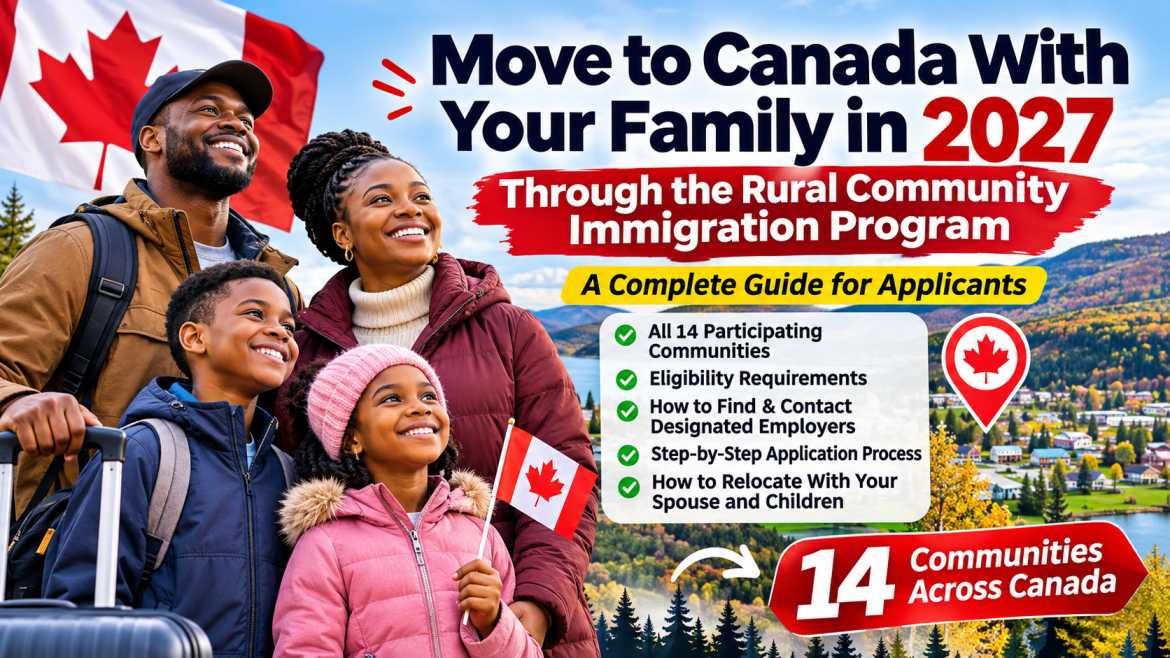
Are you looking for a way to move to Canada with your spouse and children in 2027 without relying entirely on the Express Entry system?
Canada’s Rural Community Immigration Program (RCIP) is an immigration pathway designed to help skilled foreign workers obtain permanent residence while filling labour shortages in smaller Canadian communities.
The programme offers an opportunity for qualified foreign workers to secure employment with designated Canadian employers, obtain a community recommendation and apply for permanent residence.
One of the biggest advantages is that eligible applicants can include their immediate family members in their permanent residence application. This means you can potentially relocate to Canada with your spouse and dependent children rather than travelling alone and arranging their relocation later.
Canada initially selected 14 communities to participate in the Rural Community Immigration Pilot (RCIP). These communities are located across six provinces and have different labour market needs, designated employers and priority occupations.
Important 2027 update: On November 9, 2026, Immigration, Refugees and Citizenship Canada (IRCC) announced that the original Rural Community Immigration Pilot will close on January 1, 2027, and transition into a permanent Rural Community Immigration Program. The new programme will retain the community-driven and designated-employer model. The 14 original communities are expected to participate in the permanent programme.
This guide explains the 14 communities, eligibility requirements, how to identify designated employers, where to find job opportunities and how to prepare your application for 2027.
1. What Is Canada’s Rural Community Immigration Program?
The Rural Community Immigration Program is a federal economic immigration pathway that allows skilled foreign workers to obtain Canadian permanent residence through participating rural communities.
The programme was introduced to help smaller Canadian communities address labour shortages and attract skilled workers who are willing to live and work outside Canada’s major metropolitan areas.
Unlike some immigration programmes where applicants compete through a points-based ranking system, the Rural Community Immigration Program is built around employment and community needs.
The process generally involves:
- Identifying a participating community.
- Finding employment with a designated employer in that community.
- Receiving a qualifying job offer.
- Obtaining a community recommendation.
- Applying for permanent residence through IRCC.
The community assesses whether the job offer is genuine, whether the occupation meets its priorities and whether the applicant satisfies its programme requirements.
IRCC then makes the final decision on the permanent residence application.
Can you move with your family?
Yes. Eligible applicants can include their spouse or common-law partner and dependent children in their permanent residence application.
However, every accompanying family member must meet the applicable immigration, medical and admissibility requirements.
This is particularly important for families who want to establish themselves in Canada together.
2. The 14 Communities Participating in the Rural Community Immigration Program
The original RCIP selected 14 communities across six Canadian provinces.
Each community has its own economic priorities, designated employers and recruitment process. You should not assume that an occupation accepted in one community will automatically qualify in another.
Below is a breakdown of all 14 communities and their official programme websites.
1. Pictou County, Nova Scotia
Pictou County is located in northeastern Nova Scotia and offers opportunities for people interested in settling in a smaller Canadian community.
Potential employment sectors to investigate include:
- Healthcare and social assistance.
- Manufacturing.
- Agriculture and food production.
- Skilled trades.
- Hospitality and tourism.
- Transportation and logistics.
Applicants should review the community’s current priority occupations before applying for jobs.
Official website: https://pictoucountypartnership.com/
2. North Bay, Ontario
North Bay is located in northeastern Ontario and is known for its healthcare, education, manufacturing and service industries.
Employment sectors worth investigating include:
- Healthcare.
- Manufacturing.
- Construction and skilled trades.
- Transportation.
- Hospitality.
- Social services.
North Bay may be worth considering for applicants with relevant experience in healthcare, technical occupations and industrial employment.
Official website: https://nbrcip.ca/
3. Greater Sudbury, Ontario
Sudbury is one of Northern Ontario’s major economic centres.
The city has a strong mining and industrial economy, alongside healthcare, education and other services.
Potential employment sectors include:
- Mining and mining-related occupations.
- Healthcare.
- Manufacturing.
- Construction.
- Transportation.
- Education and social services.
People with technical, industrial and healthcare backgrounds should investigate opportunities in Sudbury.
Official website: https://investsudbury.ca/why-sudbury/move-to-sudbury/
4. Timmins, Ontario
Timmins is another Northern Ontario community with a strong mining and natural resources economy.
It also has employment opportunities in healthcare, construction, transportation and other essential services.
Potential sectors to investigate include:
- Mining.
- Healthcare.
- Manufacturing.
- Skilled trades.
- Transportation.
- Hospitality and food services.
Applicants with mining, mechanical, technical and healthcare experience may find relevant opportunities depending on the community’s current priorities.
Official website: https://timminsedc.com/
5. Sault Ste. Marie, Ontario
Sault Ste. Marie is located in Northern Ontario, close to the Canada–United States border.
Its economy includes manufacturing, healthcare, forestry, transportation and other industries.
Potential employment sectors include:
- Healthcare.
- Manufacturing.
- Forestry.
- Construction.
- Transportation and logistics.
- Hospitality.
Applicants should explore employers in the city’s industrial and healthcare sectors.
Official website: https://welcometossm.com/
6. Thunder Bay, Ontario
Thunder Bay is an important service and economic centre in Northwestern Ontario.
It has employment opportunities in several essential sectors, including healthcare, transportation, education and manufacturing.
Potential employment sectors include:
- Healthcare and social assistance.
- Transportation and logistics.
- Manufacturing.
- Construction.
- Hospitality.
- Education and social services.
Applicants with relevant experience in healthcare, industrial operations and skilled trades should investigate this community.
Official website: https://gotothunderbay.ca/
7. Steinbach, Manitoba
Steinbach is located southeast of Winnipeg and has a growing economy supported by manufacturing, agriculture, retail and transportation.
Potential employment sectors include:
- Manufacturing.
- Agriculture and food processing.
- Trucking and transportation.
- Healthcare.
- Construction.
- Retail and other services.
Applicants with manufacturing, mechanical, logistics and healthcare experience should investigate employment opportunities here.
Official website: https://steinbachedc.com/
8. Altona/Rhineland, Manitoba
Altona/Rhineland is a rural region in southern Manitoba.
The area has a strong agricultural and manufacturing economy, including food processing and printing industries.
Potential employment sectors include:
- Agriculture.
- Food processing.
- Manufacturing.
- Transportation.
- Healthcare.
- Skilled trades.
Applicants with experience in industrial production, agriculture and technical occupations should consider researching employers in this region.
Official website: https://ared-rpga.com/
9. Brandon, Manitoba
Brandon is Manitoba’s second-largest city and an important economic centre in the western part of the province.
Its economy includes agriculture, food processing, healthcare, education and manufacturing.
Potential employment sectors include:
- Healthcare.
- Food processing.
- Manufacturing.
- Agriculture.
- Transportation.
- Construction.
Brandon is worth investigating for applicants with experience in healthcare, industrial production, agriculture and technical occupations.
Official website: https://economicdevelopmentbrandon.com/
10. Moose Jaw, Saskatchewan
Moose Jaw is located in southern Saskatchewan and has an economy supported by agriculture, manufacturing, transportation and services.
Potential employment sectors include:
- Agriculture and food production.
- Manufacturing.
- Healthcare.
- Transportation.
- Construction.
- Hospitality.
Applicants with experience in industrial operations, agriculture, healthcare and skilled trades should investigate available positions.
Official website: https://rcip.mjchamber.com/
11. Claresholm, Alberta
Claresholm is a smaller community located in southern Alberta.
The region has economic activities connected to agriculture, healthcare, manufacturing and local services.
Potential employment sectors include:
- Healthcare.
- Agriculture.
- Manufacturing.
- Construction.
- Transportation.
- Hospitality.
Applicants interested in smaller communities and employment outside major cities may consider Claresholm.
Official website: https://claresholm-rcip.ca/
12. West Kootenay, British Columbia
West Kootenay is a region in southeastern British Columbia that includes communities such as Nelson, Castlegar, Trail and Rossland.
Its economy includes manufacturing, forestry, healthcare, education and tourism.
Potential employment sectors include:
- Healthcare.
- Manufacturing and metallurgy.
- Forestry.
- Skilled trades.
- Tourism and hospitality.
- Education.
Applicants with technical, industrial and healthcare backgrounds should investigate the region’s employers.
Official website: https://wk-rnip.ca/
13. North Okanagan-Shuswap, British Columbia
North Okanagan-Shuswap is located in the interior of British Columbia and includes areas around Vernon and Salmon Arm.
The region has a diverse economy involving agriculture, tourism, manufacturing and healthcare.
Potential employment sectors include:
- Agriculture.
- Healthcare.
- Manufacturing.
- Tourism and hospitality.
- Construction.
- Transportation.
Applicants with experience in agriculture, food production, healthcare and technical occupations should explore opportunities in this region.
Official website: https://rcipnorthokanaganshuswap.com/
14. Peace Liard, British Columbia
Peace Liard is located in northeastern British Columbia and includes communities within the Peace River and surrounding region.
Its economy is connected to energy, agriculture, forestry, construction and public services.
Potential employment sectors include:
- Energy and natural resources.
- Agriculture.
- Construction.
- Skilled trades.
- Healthcare.
- Transportation and logistics.
Applicants with experience in industrial operations, mechanical trades, construction and healthcare should investigate the opportunities available.
Official website: https://www.nebcimmigration.ca/
Important: The employment sectors listed above are areas to investigate, not confirmation that every occupation is eligible. Each community publishes its own priority occupations and designated employers. Always check the current 2027 lists before submitting an application.
3. Requirements for the Rural Community Immigration Program in 2027
The new permanent programme is scheduled to open on January 1, 2027.
The official IRCC eligibility framework published on November 9, 2026, identifies the following core requirements.
A. A valid job offer from a designated employer
You must obtain a valid job offer from an employer designated by one of the participating communities.
This is one of the most important requirements.
Not every Canadian company can recruit foreign workers through this programme.
The employer must be officially designated by the relevant community, and the position must meet the programme’s requirements.
You should confirm the employer’s designation before proceeding with an application.
B. Relevant work experience
Applicants must generally have at least one year of relevant work experience, equivalent to 1,560 paid hours, within the three years preceding the application.
Your previous experience must be relevant to the job you are being offered.
The experience must:
- Be paid employment.
- Include the relevant duties of the occupation.
- Match the applicable NOC and TEER requirements.
- Be supported by appropriate employment documentation.
Self-employment and unpaid internships do not count towards the standard work experience requirement.
There is an exemption for certain international graduates who completed eligible programmes at publicly funded post-secondary institutions in the recommending community.
C. English or French language requirements
You must demonstrate your language proficiency through an approved language test.
The minimum language requirement depends on the TEER category of the job offer.
| Job offer category | Minimum language requirement |
| TEER 0 or 1 | CLB 6 |
| TEER 2 or 3 | CLB 5 |
| TEER 4 or 5 | CLB 4 |
Accepted English tests include:
- IELTS General Training.
- CELPIP-General.
- PTE Core.
Accepted French tests include:
- TEF Canada.
- TCF Canada.
Your test results must be less than two years old when you apply.
Applicants should note that IELTS Academic is not the accepted IELTS test for this immigration requirement.
D. Educational qualifications
You must have completed at least a Canadian secondary school education or an equivalent foreign qualification.
If your education was completed outside Canada, you will generally need an Educational Credential Assessment (ECA).
The assessment must confirm that your foreign qualification is equivalent to the required Canadian educational standard.
Some recognised ECA organisations include:
- World Education Services (WES): https://www.wes.org/
- International Credential Assessment Service of Canada (ICAS): https://www.icascanada.ca/
- Comparative Education Service (CES): https://learn.utoronto.ca/
- International Qualifications Assessment Service (IQAS): https://www.alberta.ca/iqas
An ECA used for immigration purposes must be less than five years old when you apply.
E. Settlement funds
You must demonstrate that you have sufficient funds to support yourself and your family after arriving in Canada.
The amount depends on the size of your family.
IRCC’s published settlement-funds table lists the following amounts:
| Family size | Required funds (CAD) |
| 1 person | $10,507 |
| 2 people | $13,080 |
| 3 people | $16,080 |
| 4 people | $19,524 |
| 5 people | $22,143 |
| 6 people | $24,975 |
| 7 people | $27,806 |
For each additional family member beyond seven, add $2,831.
These are the published figures updated July 29, 2025. Applicants should check IRCC for any revised 2027 amounts before applying.
You do not need to provide settlement funds if you are already working in Canada with a valid work permit.
F. Intention to live in the participating community
You must genuinely intend to settle in the community that recommends you.
This is not a programme where you obtain a job offer in a small town and immediately relocate to Toronto, Vancouver or another major city.
Your application should demonstrate a genuine intention to work and establish your life in the recommending community.
G. Community recommendation
A qualifying job offer does not automatically give you permanent residence.
You must also obtain a recommendation certificate from the participating community.
The community will assess your job offer, your eligibility and whether your employment meets its economic priorities.
Only after receiving the recommendation can you proceed with the permanent residence application.
4. How to Find Designated Employers Hiring Foreign Workers
This is where many applicants struggle.
They understand the immigration requirements but do not know where to find employers willing and authorised to recruit international applicants.
The good news is that each participating community has an official website where it publishes information about the programme, designated employers and recruitment opportunities.
Here is how to approach your job search.
Step 1: Choose your preferred community
Start by selecting two or three communities where your occupation and work experience match the local labour market.
Do not apply randomly to all 14 communities.
For example, an applicant with mining experience may investigate Timmins, Sudbury and West Kootenay.
An applicant with agricultural or food-processing experience may investigate Altona/Rhineland, Brandon and Steinbach.
Step 2: Visit the official RCIP website
Use the community links provided in this article.
Look for sections with titles such as:
- Designated Employers.
- Approved Employers.
- Job Opportunities.
- Priority Occupations.
- Employment Opportunities.
- Apply for RCIP.
Download the employer list if one is available.
Step 3: Identify the employers
Once you find the designated employer list, identify companies recruiting workers in your occupation.
Do not limit your search to job vacancies published on the community website.
You can also visit the employer’s official careers page and search for available positions.
However, remember that the specific position must qualify under the programme. Being a designated employer does not mean every job it advertises is automatically eligible.
Step 4: Apply directly to the employer
Prepare a Canadian-style CV or resume and a cover letter that clearly explains:
- Your relevant work experience.
- Your professional qualifications.
- Your skills and certifications.
- How your experience matches the advertised position.
- Your willingness to relocate to the community.
Where possible, apply through the employer’s official recruitment portal.
You can also contact the company’s human resources department to enquire about vacancies.
Step 5: Confirm that the job qualifies
Before accepting an offer, confirm that:
- The employer is designated.
- The position is within the community’s priority occupations.
- The position meets the programme’s job-offer requirements.
- You meet the work experience and language requirements.
5. How to Contact Canadian Employers Directly
You do not always have to wait for an employer to contact you.
You can take the initiative by approaching designated employers with a professional application.
Here is an example of an email you can send.
Subject: Application for Employment Opportunity – [Your Occupation]
Dear Hiring Manager,
I hope you are doing well.
My name is [Your Name], and I am writing to express my interest in employment opportunities with your organisation.
I have [number of years] of experience in [your occupation/industry], with practical experience in [mention your relevant skills].
I understand that your organisation participates in Canada’s Rural Community Immigration Program. I am interested in opportunities that match my qualifications and professional experience.
I would appreciate the opportunity to be considered for any suitable vacancies within your organisation.
I am prepared to relocate to your community and contribute positively to your organisation.
Please find my CV attached for your consideration.
Thank you for your time. I look forward to hearing from you.
Kind regards,
[Your Name]
[Email Address]
[Phone Number]
A few important tips:
- Personalise your email for each employer.
- Attach a properly formatted CV.
- Apply for positions that match your experience.
- Avoid sending the same generic email to hundreds of companies.
- Follow up professionally if you do not receive a response.
Do not pay an employer for a job offer or a community recommendation. Genuine employment opportunities should be verified directly with the employer and community.
6. How to Move to Canada With Your Spouse and Children
One of the attractive features of this immigration pathway is that successful applicants can include eligible family members in their permanent residence applications.
If you are married and have children, you should declare them in your application, whether or not they will accompany you immediately.
Your family members may include:
- Your legally married spouse or eligible common-law partner.
- Your dependent children.
- Your spouse’s eligible dependent children.
All applicable family members must be declared and undergo the required immigration checks.
Can my spouse and children receive permanent residence too?
Eligible accompanying family members can receive permanent residence when the principal applicant is approved, subject to their individual admissibility requirements.
Can my spouse work in Canada?
Your spouse’s eligibility for a work permit is subject to the applicable family work-permit rules at the time of application. Do not assume that a work permit is automatically granted simply because you qualify under the programme.
Can my children attend school in Canada?
Children who obtain permanent resident status can access education under the applicable provincial rules.
This makes the programme an option worth investigating for families looking to establish themselves in Canada over the long term.
7. The Application Process: Step by Step
Here is the general process applicants should prepare for under the new permanent programme.
Step 1: Check your eligibility
Review your work experience, educational qualifications, language proficiency and settlement funds.
Step 2: Choose a participating community
Select a community where your occupation matches the local labour market needs.
Step 3: Find a designated employer
Use the official community website to identify designated employers and available vacancies.
Step 4: Secure a qualifying job offer
Apply for a suitable position and obtain a genuine job offer from a designated employer.
Step 5: Apply for a community recommendation
The employer submits the recommendation application to the community through the applicable process.
The community reviews your eligibility and the job offer.
Step 6: Receive your recommendation certificate
If the community approves your application, it issues a recommendation certificate.
Step 7: Apply for permanent residence
Submit your application to IRCC with the required documents, including your recommendation certificate.
Step 8: Complete the immigration checks
You and your accompanying family members must complete the applicable medical, criminality, security and other admissibility requirements.
Step 9: Receive a decision
IRCC makes the final decision on your permanent residence application.
Eligible applicants may also be able to apply for an optional employer-specific work permit while their permanent residence application is being processed. This is subject to the applicable requirements.
8. Documents You Should Start Preparing
If you intend to apply in 2027, you should begin organising your documents early.
Some of the documents you may need include:
- International passport.
- Updated CV or resume.
- Educational certificates.
- Academic transcripts.
- Educational Credential Assessment.
- IELTS General Training, CELPIP-General or PTE Core results.
- Employment reference letters.
- Previous employment contracts.
- Payslips and other evidence of paid employment.
- Proof of settlement funds, where required.
- Marriage certificate, where applicable.
- Birth certificates for dependent children.
- Police certificates.
- Medical examination documents, as instructed by IRCC.
- Valid job offer.
- Community recommendation certificate.
Your employment reference letters should clearly describe your job duties, employment dates, salary, hours worked and employer contact details.
Ensure that your work experience documents accurately reflect the occupation you are claiming.
9. Important Things to Know Before Applying
There are several things applicants should understand before committing money to the process.
A job offer does not guarantee permanent residence.
You must meet all the federal and community requirements.
Not every Canadian employer is eligible.
Only designated employers can make qualifying job offers under this pathway.
Not every occupation qualifies.
Each community has priority sectors and occupations. Check the current list before applying.
You must be willing to settle in the community.
The programme is intended to support rural communities, not serve as a shortcut to settle immediately in Canada’s largest cities.
Be careful of immigration scams.
Avoid individuals who promise guaranteed jobs, guaranteed community recommendations or guaranteed permanent residence.
Verify the employer directly and use the official IRCC website for immigration information.
10. Is the Rural Community Immigration Program Worth Considering in 2027?
For skilled foreign workers who have relevant work experience and are willing to relocate to smaller Canadian communities, this pathway is worth investigating.
It may be particularly relevant to applicants working in healthcare, manufacturing, agriculture, transportation, construction, skilled trades and other occupations identified by participating communities.
However, your eligibility will depend on your occupation, work experience, language results, educational qualifications and the requirements of your chosen community.
The transition from the original pilot to a permanent programme is also an important development for people planning their Canadian immigration journey in 2027.
Rather than focusing only on Toronto, Vancouver or other major cities, applicants should explore opportunities in Canada’s smaller communities.
For families, the possibility of obtaining permanent residence together makes this pathway particularly interesting.
Final advice: Do not wait until you see a job vacancy before preparing your documents. Start working on your CV, language test, educational assessment and employment references now. Research the 14 communities and identify the employers that match your professional background.
Official Government Resources
For the most accurate and updated information, always refer to the Canadian government’s official immigration resources.
- Rural Community Immigration Program: https://www.canada.ca/en/immigration-refugees-citizenship/services/immigrate-canada/rural-franco-pilots/rural-immigration-program.html
- Programme eligibility: https://www.canada.ca/en/immigration-refugees-citizenship/services/immigrate-canada/rural-franco-pilots/rural-immigration-program/eligibility.html
- Job offer and community recommendation: https://www.canada.ca/en/immigration-refugees-citizenship/services/immigrate-canada/rural-franco-pilots/rural-immigration-program/job-offer.html
- Work experience requirements: https://www.canada.ca/en/immigration-refugees-citizenship/services/immigrate-canada/rural-franco-pilots/rural-immigration-program/eligibility/work-experience.html
- Language requirements: https://www.canada.ca/en/immigration-refugees-citizenship/services/immigrate-canada/rural-franco-pilots/rural-immigration-program/eligibility/language-test.html
- Educational requirements: https://www.canada.ca/en/immigration-refugees-citizenship/services/immigrate-canada/rural-franco-pilots/rural-immigration-program/eligibility/education-assessment.html
- Settlement funds: https://www.canada.ca/en/immigration-refugees-citizenship/services/immigrate-canada/rural-franco-pilots/rural-immigration-program/eligibility/proof-funds.html
Disclaimer: Talk2Sam Africa shares immigration information for educational purposes. We are not the Canadian government and do not issue job offers, employer designations or immigration approvals. Programme requirements and participating community lists may change. Always verify information with IRCC and the relevant community before making immigration decisions.