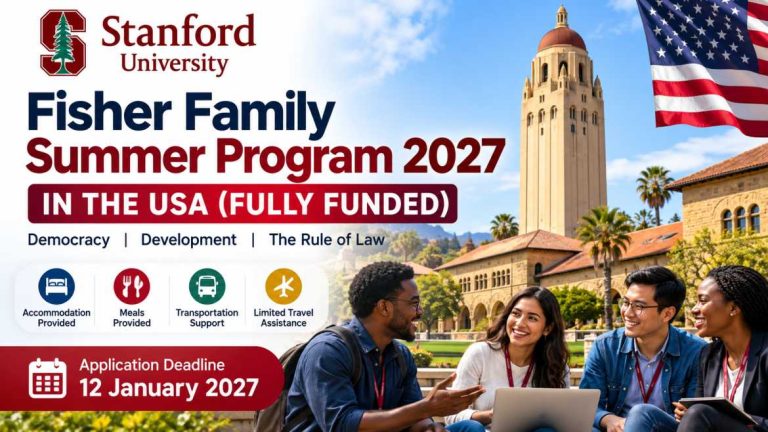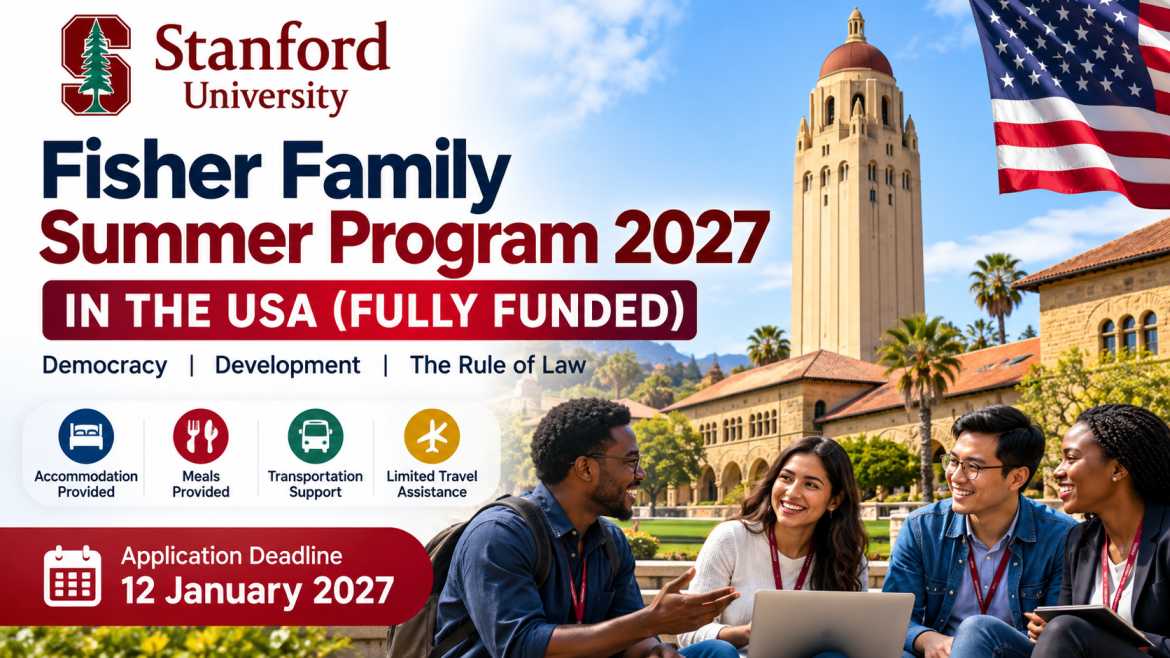
Applications are now open for the Stanford Fisher Family Summer Fellows Program 2027 in the United States. Hosted by Stanford University’s Center on Democracy, Development and the Rule of Law (CDDRL), this international fellowship brings together experienced professionals working to strengthen democracy, improve governance, and promote economic and legal development in their home countries.
Previously known as the Draper Hills Summer Fellows Program, the fellowship provides an intensive three-week learning experience on Stanford’s campus in California. Approximately 28–30 professionals will be selected to participate in academic sessions, exchange ideas with international peers, and learn from leading Stanford faculty.
The programme is designed primarily for mid-career practitioners who have demonstrated leadership and made meaningful contributions to democracy, development, or the rule of law. Applicants from countries where democratic institutions remain fragile or face significant challenges are particularly encouraged to review the eligibility criteria.
The fellowship provides accommodation, meals, and transportation support during the programme. Limited travel assistance may also be available to fellows who cannot afford their journey to California.
Stanford Fisher Family Summer Program 2027: Overview
- Host institution: Stanford University
- Organising centre: Center on Democracy, Development and the Rule of Law (CDDRL)
- Country: United States
- Location: Stanford, California
- Programme dates: July 18 – August 6, 2027
- Duration: Three weeks
- Expected cohort: Approximately 28–30 fellows
- Theme: Democracy, Development, and the Rule of Law
- Funding: Programme-related support, with limited travel assistance available
- Application fee: None
- Application deadline: January 12, 2027, at 11:59 p.m. Pacific Standard Time
- Official application page
About the Stanford Fisher Family Summer Fellows Program
The Fisher Family Summer Fellows Program was established in 2005 to support professionals working to advance democratic governance, economic development, and the rule of law in countries undergoing political or institutional transitions.
The fellowship offers participants an opportunity to examine contemporary challenges affecting democratic institutions and explore practical approaches to reform. Through academic discussions, case studies, and exchanges with fellow practitioners, participants develop new perspectives that can strengthen their work at home.
Stanford faculty and other experts lead sessions covering democracy, governance, development, and legal institutions. Fellows also become part of an international professional network of people working to create positive change in their societies.
The programme is not intended primarily for students seeking an academic fellowship. Instead, it focuses on experienced practitioners who are already contributing to public policy, civil society, economic development, or related fields.
Financial Benefits
The Stanford Fisher Family Summer Fellows Program provides support to help participants take part in the three-week programme.
The listed benefits include:
- Accommodation: Housing during the fellowship on Stanford’s campus.
- Meals: Meals provided as part of the programme arrangements.
- Transportation: Transportation support associated with programme participation.
- Limited travel assistance: A small travel fund may be available to fellows who cannot afford their journey to California.
- Academic training: Access to intensive sessions led by Stanford faculty and other experts.
- Professional networking: Opportunities to connect with leaders and practitioners from different countries.
Is the Stanford Fisher Family Summer Program Fully Funded?
Applicants should read the funding conditions carefully. Although the opportunity is frequently described as fully funded, Stanford indicates that fellows may need to contribute towards the cost of participation. Limited, need-based travel assistance is available, with priority given to applicants facing significant financial barriers or exceptionally high airfare costs.
Therefore, international applicants should not assume that every expense, including all international flights and incidental costs, will automatically be covered.
Who Can Apply?
The fellowship is intended for mid-career professionals who are actively working to advance democracy, development, and the rule of law.
Eligible professional backgrounds may include:
- Government officials and policymakers.
- Academics actively involved in public policy or democratic development.
- Lawyers and legal professionals.
- Civil society leaders.
- Non-governmental organisation (NGO) representatives.
- Journalists and media professionals.
- Social entrepreneurs and business entrepreneurs.
- Leaders of trade unions and professional associations.
- Specialists in economic development and governance.
Applicants should have a strong record of professional achievement and occupy a position that allows them to influence political, economic, or social development in their country.
The programme prioritises practical experience and demonstrated leadership rather than academic qualifications alone.
Eligibility Requirements
Applicants should carefully assess the following criteria before beginning the application.
1. Country of Origin and Residence
Candidates must come from and currently reside in a country where democracy is not firmly established. Applicants from highly democratic countries, including the United States, Canada, Australia, Japan, and European Union member states, are not eligible under the programme’s standard criteria.
Exceptions may be considered for candidates living outside their home countries because of war or conflict.
2. Professional Experience
Applicants must be mid-career practitioners with at least 10–12 years of professional experience. Their work should relate directly to democracy, development, public policy, governance, or the rule of law.
3. Age Requirement
Candidates must be at least 28 years old when the fellowship begins in July 2027.
4. Relevant Professional Responsibilities
Applicants should be actively engaged in their fields and have demonstrated professional achievements. They should hold meaningful responsibilities that enable them to contribute to development or democratic reform.
5. Academic Background
A bachelor’s degree is common among previous fellows, but Stanford states that it is not an absolute admission requirement. Applicants must nevertheless have the academic and professional preparation needed to participate in intensive discussions and advanced reading.
6. English-Language Ability
Applicants must have a strong command of written and spoken English because the programme’s sessions, materials, and discussions are conducted in English.
7. University Enrolment
Individuals currently enrolled in full-time university degree programmes are not eligible.
8. Commitment to the Full Programme
Successful candidates must be available to participate throughout the fellowship, from July 18 to August 6, 2027.
Is IELTS or TOEFL Required?
Stanford does not list IELTS or TOEFL as compulsory application documents for this fellowship. However, applicants must demonstrate strong English-language communication skills.
Participants are expected to engage in academic discussions, understand advanced reading materials, and deliver a presentation of approximately seven minutes about their work and motivation.
Applicants should therefore be confident in their ability to communicate professionally in English, even if they have not taken a standardised language test.
Required Application Documents
The online application includes several sections that applicants must complete carefully.
Prepare the following information and materials:
- Personal and applicant information.
- Academic and career history.
- Resume or curriculum vitae (CV).
- Responses to the essay questions.
- English-language proficiency information.
- A short video submission.
- Financial information.
- Personal certification.
- At least two letters of recommendation, with a maximum of three.
Stanford specifically highlights the CV, essay responses, video submission, and recommendation letters as sections requiring particular attention.
How to Apply for the Stanford Fisher Family Summer Program 2027
Follow these steps to submit your application.
Step 1: Review the official fellowship information
Visit Stanford’s official programme page and read the eligibility requirements, selection criteria, and application instructions.
Official page: https://cddrl.fsi.stanford.edu/content/dhsfapply
Step 2: Confirm your eligibility
Check the age, professional experience, country of residence, and employment requirements. This is particularly important because the fellowship targets experienced practitioners rather than full-time university students.
Step 3: Prepare your CV and essays
Create a concise CV that highlights your professional achievements. Draft your essay responses in a separate document and ensure they explain your work and its relevance to the fellowship.
Step 4: Record your application video
Prepare a compelling presentation of no more than two minutes. Explain why your experience makes you a suitable candidate and how the fellowship could strengthen your impact.
Step 5: Request recommendation letters
Contact two or three suitable professional referees early. Give them enough time to prepare and submit their letters before the deadline.
Step 6: Complete the online application
Create an account through Stanford’s application portal, complete every required section, and upload the requested documents.
Step 7: Review and submit
Check your answers, uploaded files, and recommendation-letter status before submitting. Once the application has been submitted, you cannot return to edit it.
Step 8: Monitor your email
Stanford expects to notify applicants of selection decisions by April 2027. Check your inbox and spam folder for official correspondence.
VISIT OFFICIAL WEBSITE TO APPLY
Check other opportunities:
WHO Summer School 2027 in France: Free Training Programme in Nice
LPI Summer Internship 2027 in the USA | Fully Funded Undergraduate Research Opportunity
France Excellence Eiffel Scholarship 2027 (Fully Funded)
Impact AI Fellowship 2027 in Germany (Get €5,000 Stipend)
CrossCulture Program 2027 in Germany (Fully Funded)
Raisina Young Fellows Programme 2027 in India (Fully Funded)
2027 Mandela Washington Fellowship Reader Application: Volunteer Opportunity
Keio University ADB Scholarship 2027 in Japan (Fully Funded)
Global Investigative Journalism Conference 2027 Fellowship in the Netherlands (Fully Funded)